Naturally Twiggy?
I once saw a black and white photograph of the ultra-thin model Twiggy eating what appeared to be a plate of batter- dipped fish and French fries.
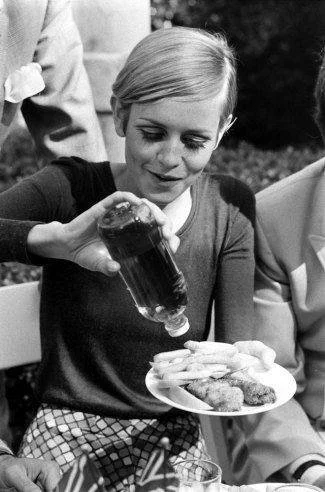
And it provoked something. It had to do with the trigger-rife connection involving her thin physique and disordered food/body image concerns.
Twiggy (real name, Lesley Lawson) was world famous for her look, one which showcased a boyish, thin body, short hair and large eyes that were further accentuated by painted- on eyelashes. Named "The Face of 1966" by The Daily Express, she took the 1960’s British Mod Scene and the fashion world by storm.
Yes, Twiggy was a game changer. And, because of her androgynous and thin appearance, she has long been criticized for promoting unhealthy body image messages.
Over the years, she has addressed those critiques when it comes to the topic of eating disorders and her own body:
"I was very skinny, but that was just my natural build. I always ate sensibly – being thin was in my genes.”
Reading that statement, therefore, brought up the concept of beauty variation.
In today’s culture, there’s been an obsession with the thin image. That’s no surprise. But, in more recent years, there’s been a growing movement to promote a variation of body shapes and sizes. Curvy, “plus size,” and “real woman” have been some of the buzz words used to describe and promote a healthier, more inclusive definition of beauty. And that’s wonderful, and, believe me, much needed, especially concerning impressionable youth.
But there is also another, less affirming and healthy message, one which is anti-thin.
I know, this is coming from me, the recovering anorexic and bulimic, who once weighed a low two-digit weight.
But there is a vast difference between the disorder sufferer who goes to great, self-destructive lengths to become emaciated and the individual whose body type is naturally thin.
When I was at the height of anorexia and at my lowest weight, I had to employ extreme, dangerous and obsessive actions to achieve that body. I starved myself and exercised for hours at a time. My thin frame required intense manipulation to make it so.
But there are individuals who naturally have thin frames. Years ago, when I came across the following statistic, the point centered on how emaciated models rarely occur naturally.
“The body type portrayed in advertising as the ideal is possessed naturally by only 5% of the American females.”
The Renfrew Center Foundation for Eating Disorders, “Eating Disorders: A Summary of Issues, Statistics, and Resources”
And, in general, that’s true. However, what is often overlooked is the actual presence of these naturally thin females. Yes, they are a rarity; nevertheless, there, indeed, are some individuals who are “naturally thin.”
I applaud body acceptance, embracing all sizes and shapes. I believe it’s wrong to confine beauty to only a thin image- and an unhealthy version of thin, at that.
But, if we believe “fat shaming” is wrong, then we also need to acknowledge “thin shaming” is wrong as well.
It’s about challenging the image message. When in doubt, talk about the matter. Have the conversation. Ask the questions. If there is a possibility of disorder, address it. If something seems to be an unhealthy image, talk about why it’s unhealthy.
But never, repeat, never, crucify the person. She- or he- may or be suffering. Or she-or he- may be naturally thin.
Regardless, talk, seek to find the answers and help as needed.
Being thin is not the problem. Self-hating, extreme mindsets and tactics, taken to exalt and create a life-threatening image, however, are.
So, with that in mind, why not accept your form, as it is right now, without conditions, without requirements? Take a page from Scripture…
“O my dove…let me see your form…for your form is lovely.”
Song of Solomon 2:14
That Truth remains. It naturally occurs for you; it naturally occurs for me.
Copyright © 2025 by Sheryle Cruse
Gaslighting’s Laughter
“For (YAH) God is not the author of confusion but of peace, as in all the churches of the saints.”
1 Corinthians 14:33
Gaslighting has become a trendy buzzword lately. It’s used to describe the crazymaking tactics often employed within an abusive dynamic.
Indeed, Wikipedia offers its own definition…
“Gaslighting is a form of psychological manipulation in which a person seeks to sow seeds of doubt in a targeted individual or in members of a targeted group, making them question their own memory, perception, and sanity. Using persistent denial, misdirection, contradiction, and lying, gaslighting involves attempts to destabilize the victim and delegitimize the victim's belief.”
It's about creating a nagging self-doubt, in which we question what we see, hear, believe and feel. Some common phrases?
“You’re crazy. You’ve lost your mind.”
“What’s wrong with you?
“Why are you so sensitive? This is no big deal.”
“You’re imagining things.”
In my personal experience, I encountered those uttered words. But I also ran into another tactic: laughter.

I’m not talking about jovial laughter, good- natured stuff.
Instead, often in tandem with these pointed phrases, I ran into dismissive, mocking laughter, utilized to deflect from real, serious issues and situations.
One family member, uncomfortable with their own angst concerning the abuse existing with our family structure, used laughter as deflection, to minimize how dangerous things were and how much behaviors needed to change.
Once, as an adolescent in pain, responding to the abuse, I bared my soul, sharing how I was experiencing suicidal thoughts. Within seconds of disclosing that revelation, this person started laughing at me, telling me I was silly. Chuckles bubbled up as I was labeled as being a” too-intense” teenager.
I felt betrayed. But even more of a betrayal?
Well, I’m sure you’ve heard how laughter can be contagious. If fact, there are actual laughing groups, sharing a human experience of contagious laughter as stress relief and bonding.
Think of that contagious reality and now visualize me, this upset teen, being laughed at over my suicidal thoughts. Soon, that contagious laughter spread to me.
I was laughing, and it betrayed my very truth. I had betrayed myself because I had succumbed to the dismissive laughter, offered by an individual whose sole agenda was to stop dealing with the seriousness of the discussed subject matter. As I laughed, as I betrayed myself, it was mission accomplished.
The message was further strengthened to both this family member and to me alike: the pain I was experiencing was silly and unimportant. I shouldn’t take my feelings seriously.
For years, I had numerous experiences with me being upset, and then, ultimately, joining in the betraying, contagious laughter.
But this suicidal discussion was the final straw.
I learned, at the tender age of thirteen, I was no longer safe discussing anything important with this person. Moreover, I learned another harmful lesson: people, in general, were unsafe. I could not risk vulnerability, for fear of being laughed at…or worse.
I also learned distrust of my feelings. Was my pain really that bad? That real? That important? After all, it was so easily “laughed off,” even by me?
What could- should- I believe about that?
Laughter, in and of itself, is not evil or wrong. We’ve all had those moments with loved ones, in which we burst out laughing, even at inopportune times, like a funeral. It’s spontaneous. The more you try to suppress the giggles, the more explosive it gets. We have a hard time controlling our laughter. We have all had that.
That, however, is a stark difference to the laughter of gaslighting.
Within that context, there is no spontaneity, no loving, “in the moment” experience of being collectively human, having a human, if not ridiculous and free, moment.
No, gaslighting’s laughter is all about agenda. What is it?
Some purposeful device to try to…
… Stop an uncomfortable conversation…
… Make someone question the validity of their pain and upset…
… Redirect focus to something or someone else…
… “Make” a problem go away.
The laughter of gaslighting is never about resolving an issue; it seeks to negate it, to manipulate it.
So, do you see your experiences here? Have you ever encountered laughter, that may have appeared innocent and jolly, but still, never felt quite right?
Have you felt the laughter was at your expense?
Have you felt it was a diversionary tactic to avoid dealing with an important issue?
Not all laughter is equal. Some of it is sinister.
And yes, some of it IS abuse.
If an episode of laughter makes you feel unheard, unseen, violated or manipulated, it’s probably because it is aimed at doing just that.
Trust your gut.
Laughter is supposed to make us feel better, not worse.
“And be kind to one another, tenderhearted, forgiving one another, even as (YAH) God in (Yahshua Ha-Mashiach) Christ forgave you.”
Ephesians 4:32
Copyright © 2025 by Sheryle Cruse
Friendships: Silver and Gold…Really?
If you were a Girl Scout, perhaps, you remember this friendship song. In my troop, we usually sang it right before we joined hands and wound ourselves into a cinnamon roll hug.
Anyway, this song has been imbedded in my head ever since. As I’m typing, I’m humming it. And, in recent days, it’s prompted a challenge to that friendship ideal...
“Make new friends, but keep the old,
One is silver and the other gold.”

Really? Should we focus on that? Accumulating- hoarding- friends?
Popular culture has been all aglow with Marie Kondo and her art of tidying. She encourages each of us to rid ourselves of whatever doesn’t “spark joy” in our lives, while we roll our socks and t-shirts.
An anti-clutter principle is employed in her method: if it no longer fits your current life, and you don’t want to carry it into your future, release it.
Therefore, I started thinking about “Kondo-ing” my relationships, a very anti-Girl Scout friendship song thing to do.
I had expelled bags, boxes, papers, clothes, and material clutter. I felt better, having done so. However, I was still overwhelmed, distracted and drained. Why? Look at my sock drawer! Look at my closet! Look at the freer, emptier space in my home! Surely, new, fresh air was circulating, right?
Not quite. I heard the song again.
“Make new friends, but keep the old,
One is silver and the other gold.”
Hello, Clutter of my unprofitable relationships.
Relationships akin to that fluorescent green crop top I purchased, believing with complete confidence, I’d wear it real life.
Or that jaunty hat.
I tend to look like I’m doing a bad impression of the late Diane Keaton in the movie, “Annie Hall.”
Still, it could not be denied. My so-called friendships were taking up space…and mocking me in the process.
So, why do I keep these relationships around? Well, like the stuff of clutter, I found there to be similar excuses, pleading for their right to exist.
1) “I might need this someday.”
It’s that dress, the one that does not fit. The “go-to,” even though I haven’t gone there in years. But I hang onto it because “it’s always been there.”
Familiar. Comforting. A safety hatch.
I had a once-close friend that fit that bill. I thought we were inseparable. We shared eerie similarities, both coming from an “only child” world view.
And those suckers have been hard to come by for me.
Anyway, I moved away years ago and we stayed in touch by phone for a while. And then, things trailed off. The calls lessened. Even Facebook messaging screeched to a halt. No “explanation.” After attempts by phone, email and social media, I got the message.
The two of us “once-close” friends…weren’t. No explosive argument. Just life moving on. Time to let go.
Most of us women live and die by our relationships. It starts early.
How many best girlfriends did you go through by the time you reached the third grade? How many times do we proclaim, “Friends forever?”
“To everything there is a season, and a time to every purpose under the heaven.”
Ecclesiastes 3:1
“People come into your life for a reason, for a season, or for a lifetime.”
I usually roll my eyes whenever that gets quoted.
But sometimes, it’s dead-on.
I struggled to hang onto a temporary “seasonal” person, trying to make then a “forever” variety.
It doesn’t work that way.
The incessant attempts to stay connected frustrated, drained, and blocked me.
Indeed, for each person you and I cling to, who is not a willing party, we say no to someone who is an enthusiastic candidate.
We need to admit truth. The “we” that represents us plus them has changed.
And we cannot change it back.
2) It’s not that bad; I can still get some use out this.
I had a purse that was kept together by safety pins.
But I was convinced I could still use it. Straps would give way in public. I’d scoop the purse up and once home, try to repair it with still more safety pins. The thing was still falling apart.
“Therefore encourage one another and build each other up, just as in fact you are doing.”
1 Thessalonians 5:11
In one friendship, I was free counseling. Repeatedly, I chose to be on the listening end of the latest tale of woe, a bad divorce, and other assorted drama. Yet, whenever I managed to slip in an issue or two of my own, suddenly, she “had to go.”
Until the next crisis.
She had a wicked sense of humor and whenever it wasn’t about the crisis du jour, we could have some great back and forth. But alas, the lion’s share of our discussion was me as a sounding board, her as a patient.
I stayed connected to her for those few fleeting good conversations. I convinced myself, “If I can just get through this hump, it’s all good. Just hang on.”
It was not about devotion. It was about some sick need that gets met from the dysfunction.
And it wasn’t just my friend’s needs. No, I got my need met from the crisis-heavy discussions. I was the comfortable therapist, nonchalantly peering in on someone’s problems. I was safely at a distance. My issues must not have been “that bad,” because I never felt an urgency to plead for them to be heard.
But that became more difficult to maintain after my Breast cancer diagnosis.
Now I needed to be heard and the status quo, one-way therapy did not work. After fifteen years, it was time to end things.
3) It over-promises, yet under-delivers.
“I've learned that people will forget what you said, people will forget what you did, but people will never forget how you made them feel.”
Maya Angelou
Years ago, I bought some high heels with leopard print all over them. They were fabulous and hobbled me every single time I tried walking in them.
I was Bambi, struggling on the frozen pond.
But I believed they were a staple; animal print, after all, is a neutral.
They’ll never go out of style. I can always count on them.
“And let us consider how to stir up one another to love and good works, not neglecting to meet together, as is the habit of some, but encouraging one another.”
Hebrews 10:24-25
I had a twenty- year friendship with someone who I thought was a supportive person.
Yet, once again, I placed myself in a situation to chase someone who really wasn’t interested in being caught.
I tried to reach her by phone. She was always “busy,” “en route to a conference,” “in a meeting.”
When I finally got ahold of her, voice- to- voice, the obligatory “what’s going on with you” question surfaced. And I finally had the chance to tell her about my Breast cancer diagnosis. She was shocked, asking why she never heard about it.
I had posted about my diagnosis on social media. We were also Facebook friends. I was not hiding.
After that voice- to- voice recap, I tried, again, to reach her by phone, to no avail. We kept setting up times to speak. She kept cancelling, again, citing “busy.”
I heard- and felt- something different.
I was not a priority relationship in her life.
I get it. Busy.
We’re all busy. Life is busy. But come on, somehow, in life, you and I find the time, make the time for who and what are truly important to us.
Once is an event, perhaps. Twice, a coincidence.
But if behavior keeps happening, that is a pattern; that is a habit. Actions do speak louder than words.
“Anxiety in a man’s heart weighs him down, but a good word makes him glad.”
Proverbs 12:25
Clutter, here in this kind of relationship dynamic is represented by the accumulation of experiences in which we are not treated as an important priority. I believe that too often, “busy” is code for “I’m not interested in you.”
Again, does it keep happening? When you walk away from this person-or this attempt at connecting with this person- how do you feel?
Pay attention to that and declutter, if necessary.
4) I don’t know. (Is ambivalence the silver or the gold? I can never keep it straight).
Once, upon receiving an online clothes order, the company threw in a gardener’s bag for free.
For customer appreciation.
The bag was yellow and came with a set of tools, to boot.
I hate gardening.
But don’t look a gift-bag in the mouth, right?
So, I added it to my closet. And never once used it. It didn’t spark joy. It was just there. Mocking me with its abundance of pockets, just perfect for holding the gardening tools.
Social media gives us the illusion of “friends,” from different eras, from different walks of life and from different locations. But how many are exactly that? Friends? Maybe counted on one hand, maybe even two?
I have accumulated clutter on social media. I’m guilty of allowing this relationship hoard to exist. I’m in the process of culling my list of individuals “following” me. Because, let’s face it, there’s no following going on with some of them. I have gotten rid of many “people of my past:” theatre comrades from my college days that I’ve never met for coffee, a few stray acquaintances from a passing interest like axe throwing (don’t judge, please).
And, yes, unfortunately, some of my supposedly true-blue friendships have also gone by the wayside because, apart from the internet, there is no evidence of the two of us in each other’s lives.
Does this sound like I’m an impossible person to know, let alone, befriend?
Perhaps. I’m working on my internal, emotional clutter.
But I think there’s a bigger issue we all share.
Some people just need to exit our lives.
No yelling, no fighting, no crying jags need to always occur.
Sometimes, things just end.
“To everything there is a season, and a time to every purpose under the heaven.”
Ecclesiastes 3:1
Instead of singing the Girl Scouts’ friendship song, maybe we should start singing “Let It Go” from Disney’s “Frozen” (Yes, I know, it’s an insufferable earwig. Many of you have probably heard a toddler belt in out at high volume in your minivan. Sorry).
Still relationship endings can be okay.
When we end a friendship, another will surface in its place, sooner or later. And, in the meantime, we can clean ourselves up a bit. We can address why we’ve gotten comfortable allowing this clutter to exist in the first place.
What need or excuse does this person fill?
What is comfortable about him/her?
What is masochistic about this dynamic?
How are we the sadist in the relationship?
Clutter obscures everything.
It could be possible that the true, meaningful relationships are from people we deemed least likely.
Or maybe they are people we have yet to meet. Regardless, we have a difficult time seeing anything silver or gold in its quality, if distracting quantity is all around us.
So, we need to ask…
Does this person truly “spark joy?” How?
Are they interacting, supportive and healthfully involved in my life?
Do they still fit in my life?
Why is this person still here?
Is this relationship silver? Is this relationship gold?
That is the song we need to sing.
Copyright © 2025 by Sheryle Cruse
IF You Know?
(My Latest Book, Available Now, On Amazon…)
IF You Know?

Identity Crisis?
What is Truth?
What is His Truth?
Two questions, tucked away in scripture for centuries.
These questions ask us and challenge every person: faith and identity issues.
Personal, spiritual, generational, controversial.
We are challenged to respond to the questions.
The answers may be unexpected.
For Out Of It…(Guard Your Heart)

Again, the heart, the heart, the heart…
Heartbroken.
You and I have been that in our lives.
That’s probably why Proverbs 4 exists.
“Guard your heart with all diligence; for out of it flow the issues of life.”
Proverbs 4:23
One of the main reasons you and I are heartbroken?
It’s about access.
We gave access to a person or to something that hurt us.
Used us. Exploited us. Abandoned us.
Because of those experiences, now we are… Guarded.
But, perhaps, not the right kind of “guarded” that we should be.
I’m a big fan of “The Wizard of Oz.”
There is the point in the story in which The Wicked Witch takes our Gingham-clad Heroine, Dorothy captive, threatening her life, all for those fabulous ruby red slippers.
(Serious shoe fetish).
Anyway, The Witch, not surprisingly, is guarded by a number of these intimidating guys…

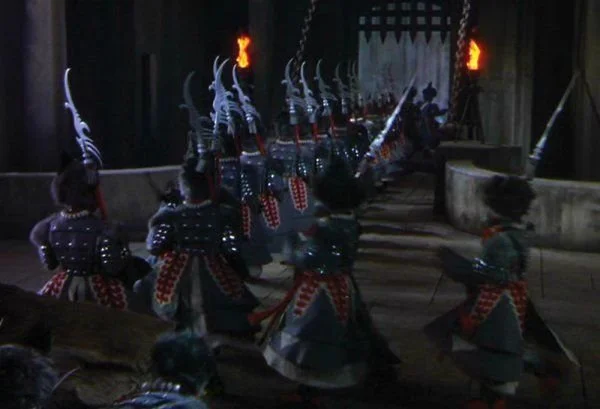
Guards.
The classic story eventually unfolds into a plan concerning Dorothy’s three destiny helpers: The Scarecrow, The Tin Woodsman, and The Cowardly Lion.
They plot to overtake the guards, wear their uniforms, blending in with the others, gaining access to the castle… to rescue to Dorothy.
A difficult feat, especially for The Cowardly Lion, with his tail being a bit conspicuous.
“The Strong Man.”
“Indeed, no one can enter a strong man’s house to steal his possessions unless he first ties up the strong man. Then he can plunder his house.”
Mark 3:27

“When a strong man, fully armed, guards his house, his possessions are secure. But when someone stronger attacks and overpowers him, he takes away the armor in which the man trusted, and then he divides up his plunder.”
Luke 11:21-22
Scripture endeavors to teach us about “The Strong Man,” not to plunder, because, after all, “Thou shalt not steal” (Exodus 20:15), but rather “To guard” our hearts.
You know…Boundaries.
“But let your ‘Yes’ be ‘Yes,’ and your ‘No,’ ‘No.’ For whatever is more than these is from the evil one.”
Matthew 5:37
Failure to guard ourselves? What can be the result of that?
“Whoever has no rule over his own spirit Is like a city broken down, without walls.”
Proverbs 25:28
We can split word hairs and play semantics.
Spirit... Heart… Tomato… Tomah-to…
What’s the difference?
Why are we getting caught up in word play, anyway?
Because it has to do with the ESSENCE of who we are.
What is it that makes us tick?
So, again…
“Guard your heart with all diligence; for out of it flow the issues of life.”
Proverbs 4:23
“…Your Heart…”

“For where your treasure is, there will your heart be also.”
Matthew 6:21
Scripture mentions the heart over 1,000 times: 730 times in The Old Testament, 105 in The New Testament.
But it’s not generalized. Oh, no.
It’s specific. Not just any heart…
Your Heart.
(As in, your heart and my heart).
“For where your treasure is, there will your heart be also.”
Luke 12:34
Now, that wouldn’t be nearly as sobering, were it not for some things we can’t get away from.
First:
“…for (Elohim) the LORD seeth not as man seeth; for man looketh on the outward appearance, but (Elohim) the LORD looketh on the heart.”
1 Samuel 16:7
Yep, He sees and knows our hearts. Nothing gets past Him.
And that wouldn’t be potentially problematic for us, if we, I don’t know, “acted right.”
But come on, you and I know we don’t quite reach that level of being, now, do we?
“He hath said in his heart, ‘I shall not be moved: for I shall never be in adversity.’”
Psalms 10:6
That sounds like incoming heartbreak; the countdown has begun.
The Most High wants us to come to Him…
“Draw nigh to (YAH) God, and He will draw nigh to you. Cleanse your hands, ye sinners; and purify your hearts, ye double minded.”
James 4:8
What’s stopping us?
Well, first, perhaps, there is the matter of “diligence/vigilance.”
“…With all diligence…”
Diligence: Its definition:
“steady, earnest, and energetic effort: devoted and painstaking work and application to accomplish an undertaking.”
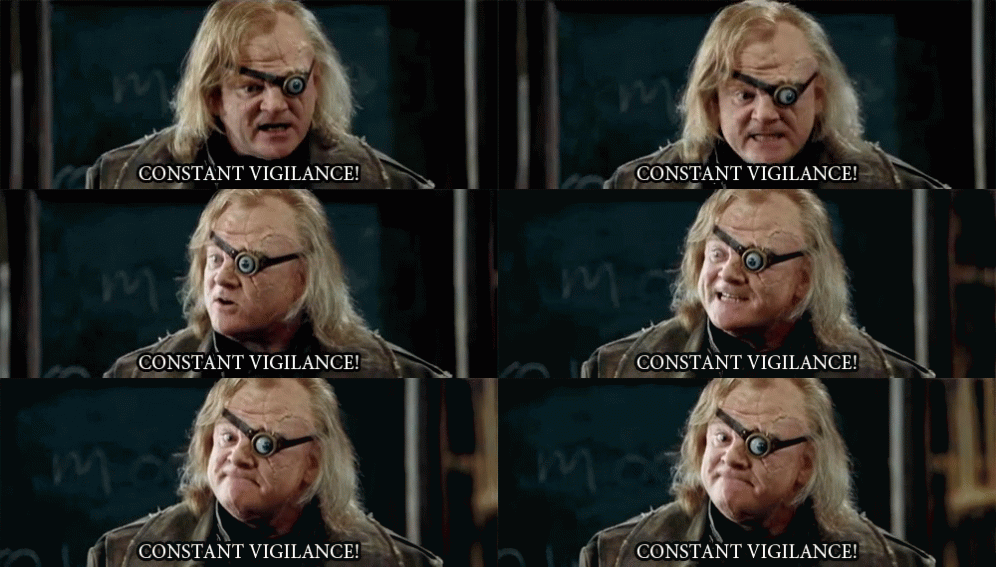
And, its twin, “Vigilance,” how about that?
Its definition:
“alertly watchful especially to avoid danger.”
Hmmm. There’s a theme here.
And again, Tomato, Tomah-to, one could argue.
Yet, what do we do with these words, and their meanings?
How do we practice “being alertly watchful and devoted”; in what DIRECTION do we practice what these words mean?
Are we searching for those answers? Are we letting Him search us?
“Search me, O (YAH) God, and know my heart: try me, and know my thoughts: And see if there be any wicked way in me and lead me in the way everlasting.”
Psalms 139:23-24
Yep, we have a choice when it comes to how we spend our lives.
Are we diligent/vigilant with our hearts and intentions?
Are we bitter, stubborn, and sinful, veering in the wrong, destructive direction?
“And whatever you do, do it heartily, as to (Elohim) the Lord and not to men.”
Colossians 3:23
Eh, that seems quite impossible and unreasonable, if we’re honest with ourselves, right?
This is about the time we run headlong into our dang hearts again…
“…For out of it…”
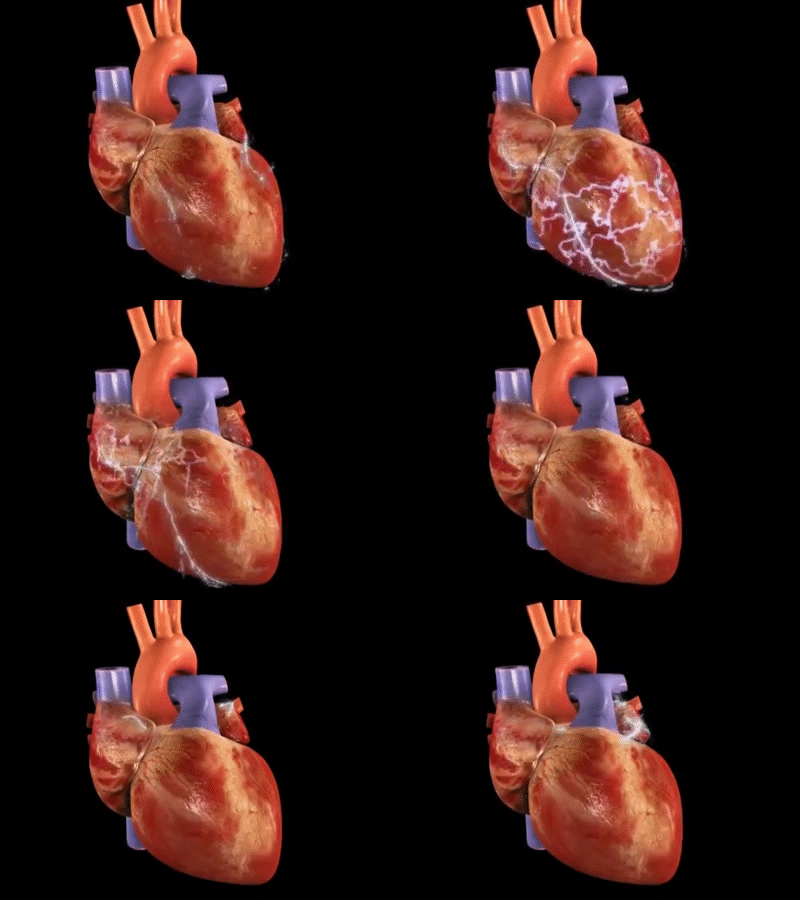
“The heart is deceitful above all things, and desperately wicked: who can know it?”
Jeremiah 17:9
This is not great news.
What is also not great news?
“He hath said in his heart, I shall not be moved: for I shall never be in adversity.”
Psalms 10:6
“He hath said in his heart, (YAH) God hath forgotten: He hideth His face; He will never see it.”
Psalms 10:11
This is also known as our defiant stance, our rebellious streak.
“For their heart was not right with him, neither were they steadfast in his covenant.”
Psalms 78:37
I know that I have grappled a lot with this issue.
It’s called asserting my own way.
And, as much as I have grappled- and let’s be real- am grappling- with this rebellious issue, how much more does He already know about it?
“But, O (Elohim) LORD of hosts, that judgest righteously, that triest the reins and the heart, let me see thy vengeance on them: for unto Thee have I revealed my cause.”
Jeremiah 11:20
Therefore, you would think that this would make it so easy for you and I to come to Him, fully surrendered, since, after all, He knows all about our hearts, anyway, right?
But no. Not quite.
“Draw nigh to (The Most High) God, and He will draw nigh to you. Cleanse your hands, ye sinners; and purify your hearts, ye double- minded.”
James 4:8
Yep. Two opposing thoughts. Double-minded.
Paul, once upon a time, put it best this way…
“But I see another law at work in my body, warring against the law of my mind and holding me captive to the law of sin that dwells within me. What a wretched man I am! Who will rescue me from this body of death?”
Romans 7:23-24
Spiritual Tug of War.
No one escapes it. We are all wretched, in one way or another.
Most of us, of course, know the “Who” that can deliver us…
Yahshua…
“For He made Him who knew no sin to be sin for us, that we might become the righteousness of (YAH) God in Him.”
2 Corinthians 5:21
What keeps, even the “best” of us from aligning with- and cooperating with- that spiritual truth?
“…Flow…”

“The heart is deceitful above all things, and desperately wicked: who can know it?”
Jeremiah 17:9
Something is the spiritual kink in the garden hose. Something is interfering with our flow.
It’s too easy to simply name that as “sin.”
Call a thing a thing and keep it moving.
Yes, we know it’s sin.
But what is the subtlety driving it, the underbelly of the sin?
Now we are at “the heart” (pun intended) of the matter.
It’s a little word we call “issues.”
“…The Issues…”
Issues- also known as problems, keep us from selectively and vigilantly guarding our hearts the way they need to and deserve to be guarded.
“Guard thy heart with all diligence; for out of it are the issues of life.”
Proverbs 4:23
As much as this word feels like a “modern-day” word, denoting therapy-speak, big time, it’s been around since this whole thing got started.
Adam and Eve- issues (Genesis 3), all the way to circa-now, with you and I struggling with the things that grip our hearts.
These issues famously include the “Seven Deadly Sins…”
Pride.
“Pride goes before destruction, And a haughty spirit before a fall.”
Proverbs 16:18
This is probably the most famous scripture about pride. Most of us have heard it, regardless of whether we have been believers. It’s that ubiquitous, in even our popular culture.
It’s ubiquitous, probably because it’s true.
How many times have the mighty fallen?
How many instances of “humbling” have you and I witnessed?
How many instances of “humbling” have you and I experienced, personally?
Yeah.
“The pride of thine heart hath deceived thee, thou that dwellest in the clefts of the rock, whose habitation is high; that saith in his heart, ‘Who shall bring me down to the ground?’”
Obadiah 1:3
Pride is one of the big issue heart-cloggers. It’s one of the things we need to be on guard about.
Not in a defensive way, which, come on, is what you and I do most of the time. We are rife with insecurity and defensiveness.
Rather, we are to be soberly on guard for the pride pitfalls. We are all vulnerable, no matter how much of a “good person” we appear to be.
Onto the next deadly sin/heart-clogging issue…
Greed.
Ah, yes. This one.
Greed is often associated with money, again, probably largely due to another famous scripture, often quoted wrong.
People often say, “Money is the root of all evil.”
Nope.
This is the scripture instead…
“For the love of money is a root of all kinds of evil, for which some have strayed from the faith in their greediness, and pierced themselves through with many sorrows.”
1 Timothy 6:10
It’s “the love of money” that is evil. It’s the hyperfocus on it, to the exclusion of everything and everyone else as important.
It’s the willingness to do anything to achieve the object of our focus and desire.
That’s evil.
Therefore, Greed, as an issue, goes beyond money.
Whatever we are obsessed with is greed.
We can be greedy for such things as…
Possessions…
Status…
A certain physical appearance…
Achievement…
Attention…
Love…
“He that is greedy of gain troubleth his own house; but he that hateth gifts shall live.”
Proverbs 15:27
Whatever our obsession is, it can soon wreck anything. We are ignorant and/or refuse to guard against the destruction that can come from its allure.
Another destructive, heart-clogging- and endangering issue?
Wrath.
“A quick-tempered person does foolish things, and the one who devises evil schemes is hated.”
Proverbs 14:17
How many of us feel great after we have lost our tempers?
Yep. Exactly.
We usually say or do something we regret.
Maybe we unleash colorful language, insulting someone.
Maybe we go for that vulnerability we know exists in another person, all to make a point.
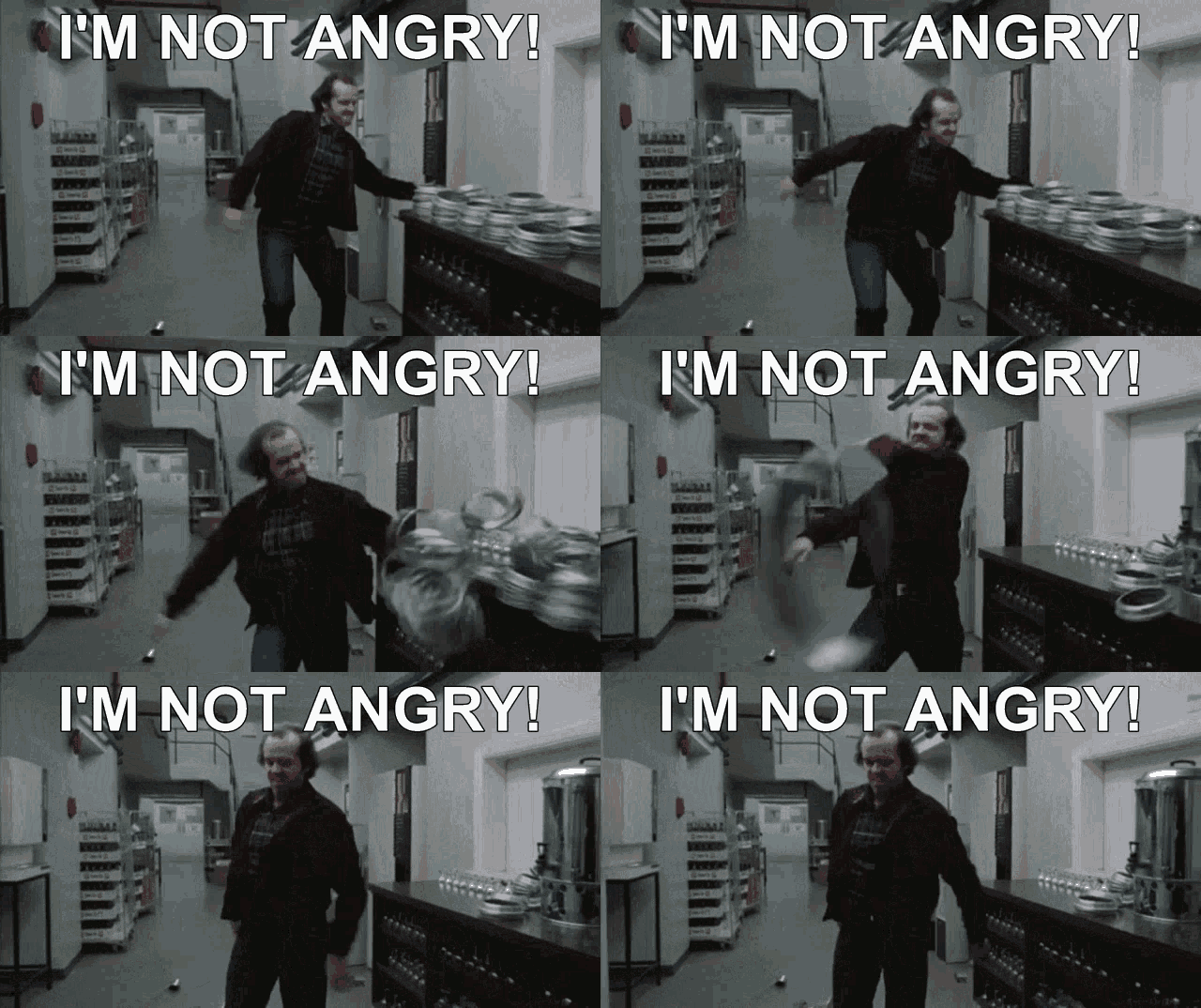
Anger destroys so easily. And so often, it is something we fail to guard, as it not only flows out of us, but rushes, like a strong river current.
Anger is a human emotion, yes. Scripture acknowledges that…
“Be angry, and do not sin”: do not let the sun go down on your wrath.”
Ephesians 4:26
This is part of the Fruit of the Spirit, you know, the self-control thing, even concerning anger?
“Because human anger does not produce the righteousness that (YAH) God desires.”
James 1:20
Yet, in the heated moment, anger can feel so gratifying to us; it’s an issue that we grapple with.
But we need to be guarded against that vulnerability.
If it flows, left unchecked, it can really do some damage.

Yeah.
That’s not good.
We really don’t want that flowing out of our lives in particular ways, now, do we?
What’s next on tap, issue-wise?
Envy.
“But if ye have bitter envying and strife in your hearts, glory not, and lie not against the truth.”
James 3:14
This sucker is closely connected, perhaps, too connected, to anger.
I mean, come on? “Bitter envying and strife?”
Yeah, that sounds like anger to me.
At least, anger-adjacent.
It can be the revenge approach, the “I’ll show them.”
It can be strict defiance of “no one’s going to make me.”
These are just a couple of avenues you and I have stumbled down.
They can lead to some desperate choices and behaviors, with potentially devastating endings.
I mean, really, how many revenge fantasies-turned-reality have the outcomes that truly satisfy us or answer the problem?
Now, how many of these choices and behaviors can lead us to further loss, pain… and even jail time?
That’s more likely, isn’t it?
And it starts with seeing and wanting what someone else has…when we want it for ourselves.
And when we strive for it, and even strive to take it?
Well…
“There is a way that seems right to a man. But its end is the way of death.”
Proverbs 14:12
“For I say, through the grace given to me, to everyone who is among you, not to think of himself more highly than he ought to think, but to think soberly, as God has dealt to each one a measure of faith.”
Romans 12:3
“The measure of faith,” I believe, speaks more to matters than just faith.
It speaks to what The Most High gives to each one of us.
Things meant uniquely, personally, and solely for us.
Things we disregard and disrespect, choosing to esteem envy of our neighbor’s stuff, instead.
And we all do it, in little ways, in big ways.
We envy. We esteem their stuff instead of appreciating our own.
I know that I’m doing it- and working through it- in about three or four different areas.
“Thou shalt not covet.”
Exodus 20:17
Yep. That’s a start.
The envy issue flourishes from there.
Moving on: the next deadly sin/issue…
Lust.
“For all that is in the world—the lust of the flesh, the lust of the eyes, and the pride of life—is not of the Father but is of the world.”
1 John 2:16
When we first think of lust, we associate it right away with sex.
And yeah, that’s there.
There’s lots of sexual sin we can get into.
But “Lust” deals more comprehensively than that, when it comes to “issues.”
Lust can be for anything: sex, power, money, fame, material possessions, any addiction or compulsion, image, or pleasure, just to name some examples.
Scripture, therefore, provides the antidote TO the Lust issue…
“I say then: ‘Walk in the Spirit, and you shall not fulfill the lust of the flesh.’”
Galatians 5:16
Is that often fun or easy… or pleasurable?
Well, since we have these seven deadly sins in our issue pile, flowing, however clogged, out of our lives, then, I guess, “No” would be that answer.
Ugly truth about us mortals?
We would rather just slide into sin, lustfully going after what we want.
“But I see another law in my members, warring against the law of my mind, and bringing me into captivity to the law of sin which is in my members.”
Romans 7:23
We become impassioned about our lusts; we are at war. It is a merciless attack.
And yeah, it touches on something that you and I cannot get away from in life: food.
Gluttony.
“Their eyes stand out with fatness: they have more than heart could wish.”
Psalms 73:7
Here is a big issue for me in my life. I have done plenty of alligator wrestling concerning it.
Having struggled with food, weight, body image, and disordered eating of all kinds, from the emaciation of Anorexia to the binge eating and subsequent obese weight gain of Bulimia and overeating, “Gluttony,” in one form or another, has been a lustful issue for me.
I have written and spoken about it, including in my book, “Thin Enough…”
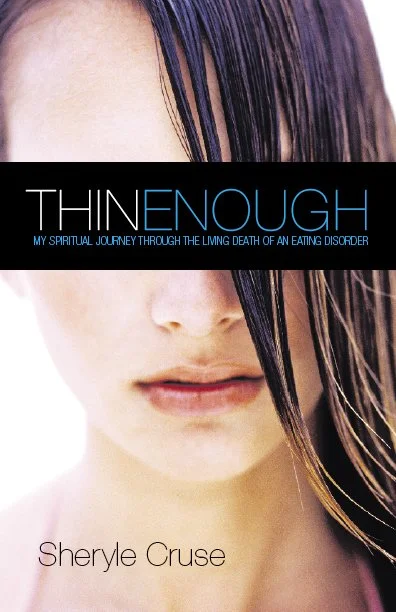
(Excerpt from “Thin Enough”)
“…Nothing else mattered anymore… Just food mattered. But things were different now. Innocence toward food was gone. I couldn’t simply ‘just eat’ again. You can’t go back once you’ve been down my road. It’s never again quite as simple as ‘eat.’
I suddenly became aware of all the food around me: food that I had sworn off, food I’d forbidden. When my alone in our apartment, I was tortured by my roommates’ food. I was hungry. And I was tempted.
‘Come on, just this once, and then you’ll get back on track.’
‘Come on, your roommates will never miss this food. They’ll never know it’s gone. Besides, it’s just this once, and then you’ll get back on track.’
I’d always believed that stealing was wrong, one of the commandments, right? But I was so hungry, right and wrong didn’t matter…”
“They willfully tested (YAH) God by demanding the food they craved.”
Psalm 78:18
Gluttony is a heart issue. It’s about focus. It’s about an exorbitant amount of attention concerning food: for pleasure, for comfort, for relief, for entertainment.
Too much of a good thing?
Trying to fill the hole within us. The space only meant for Him. The Most High.
Food, through Gluttony, is our edible “drug of choice.”
Still, you and I can try to fill ourselves up with food. Hoping to be satisfied.
The result of gluttony though?
“Do not mix with winebibbers, Or with gluttonous eaters of meat; For the drunkard and the glutton will come to poverty, And drowsiness will clothe a man with rags.”
Proverbs 23:20-21
Wrecking our bodies, lives, futures, and health.
There’s a lot of destruction.
Gluttony can kill the body. But it also soul kills as well.
I know from too much experience on this issue.
Yahshua gives us the challenging Example to follow…
“…‘My food is to do the will of Him who sent Me, and to finish His work.’”
John 4:34
Do we follow?
That’s the question we answer in life. We need help answering it.
Our free will and issues don’t make it easy.
The gluttonous issue can flow out of our hearts, into our lives.
It is not simply about “eating too much.”
Again, we need His help.
And now, the final deadly sin…
Sloth.
“How long will you lie there, O sluggard? When will you arise from your sleep?”
Proverbs 6:9
Sloths, as animals, are adorable.

Sloths, in human form?
Not so much.
“A little sleep, a little slumber, a little folding of the hands to rest, and poverty will come upon you like a robber, and want like an armed man.”
Proverbs 6:10-11
We have all been sloth like, in our behaviors.
Mindlessly wasting time. Scrolling our phones. Social media. Sleeping in.
“Love not sleep, lest you come to poverty; open your eyes, and you will have plenty of bread.”
Proverbs 20:13
Just not getting around to what we know we should do.
I’m guilty.
On the surface, it can look harmless. It’s not life or death, right?
Maybe one scroll of the phone or late morning in bed isn’t.
But it is not just a “one and done thing.”
The deadliness- the destruction- comes in when it is cumulative.
“Slothfulness casts into a deep sleep, and an idle person will suffer hunger.”
Proverbs 19:15
When it’s days-weeks-months-years, even decades- of slothful choice after slothful choice.
It adds up.
Whew! Seven Deadly Sins! So, we covered that. We can deal with these seven things, right?
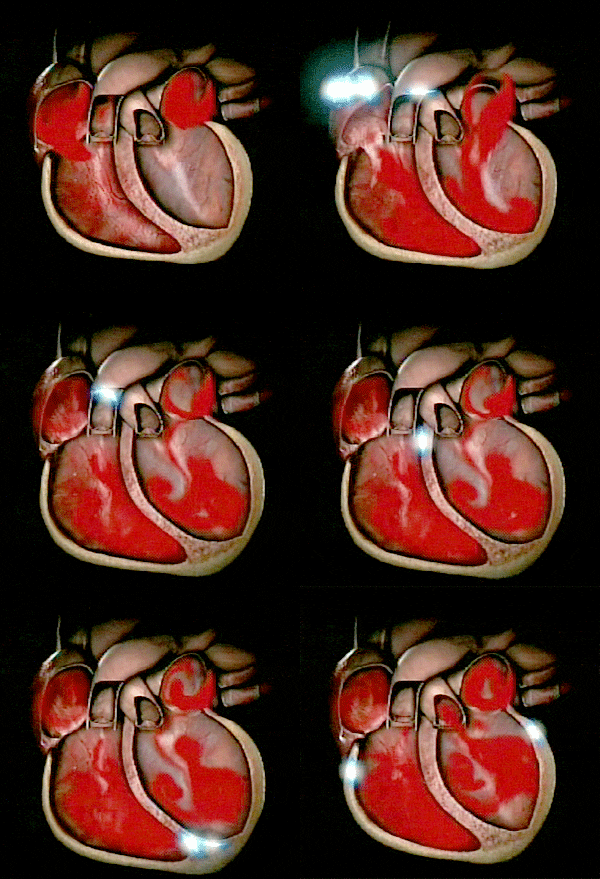
Well…
“For out of the heart proceed evil thoughts, murders, adulteries, fornications, thefts, false witness, blasphemies:”
Matthew 15:19
Yeah, great. MORE sins. MORE issues. Pumping and flowing right OUT of us!
Matthew 15, perhaps, lists some of the fallout results from the original seven deadly sins.
Still, they are “Issues.”
“For what I’m doing…”
“I do not understand what I do. For what I want to do, I do not do. But what I hate, I do.”
Romans 7:15
A hallmark of having “issues” in life.
We don’t know why we do what we do.
Mindless habits and compulsions. Almost instinct now. We don’t even pause. It’s routine.
It’s like breathing.
“For their heart was not right with him, neither were they steadfast in his covenant.”
Psalms 78:37
But that habit, behavior, sin, and issue got its start somewhere, for some reason, right?
Are we willing to investigate?
Are we willing to get searched?
“Search me, O (YAH) God, and know my heart: try me, and know my thoughts: And see if there be any wicked way in me, and lead me in the way everlasting.”
Psalms 139:23-24
If we ask, He will do it. And He will do some big-time heart surgery on us as well.
“A new heart also will I give you, and a new spirit will I put within you: and I will take away the stony heart out of your flesh, and I will give you an heart of flesh.”
Ezekiel 36:26
How are we doing with that possibility? Who is getting searched- frisked- in the heart right now?
How many of us are reluctant, refusing the search and rescue, the new heart surgery?
Most, if not all of us, are, at least, some of the time, anyway, right?
Again, it’s not a “one and done.”
It’s ongoing. Situational.
Individual, tricky, personal, heart issue by heart issue.
“For where your treasure is, there will your heart be also.”
Luke 12:34
“…Of Life.”
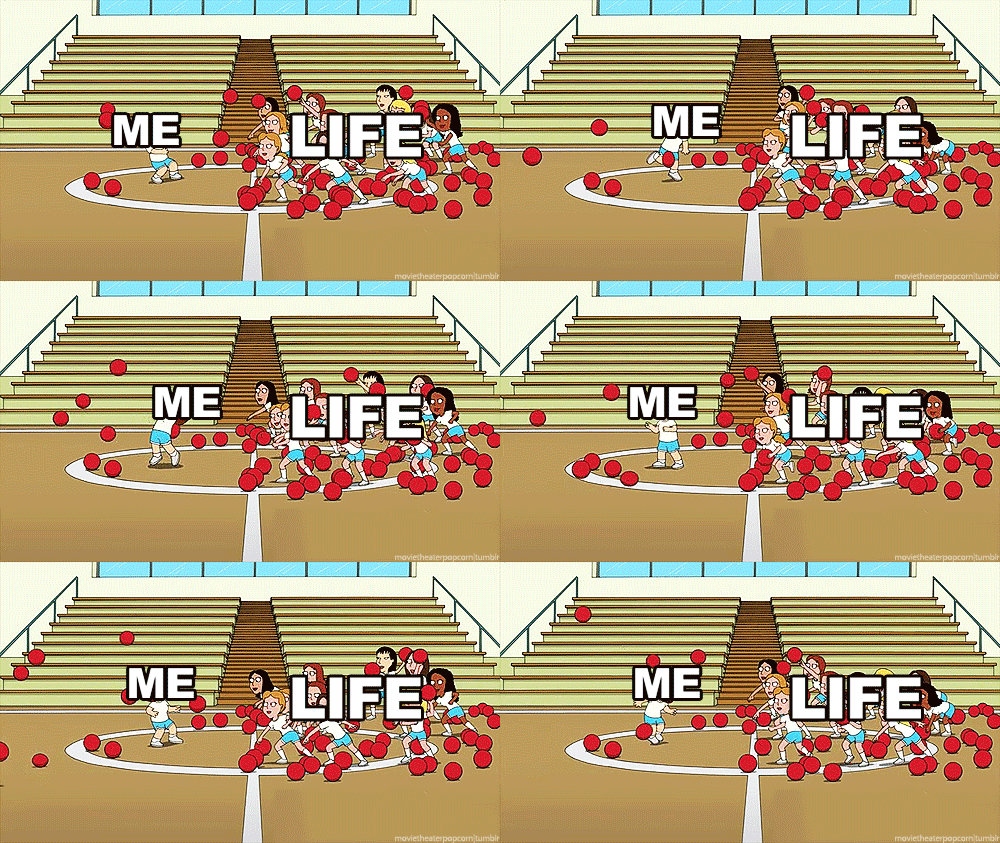
“To everything there is a season, and a time to every purpose under the heaven.”
Ecclesiastes 3:1
Life be Life-in’.
“Let not your heart be troubled: ye believe in (YAH) God, believe also in Me.”
John 14:1
7 deadly sins, for starters.
Grief, loss, love, new things, growing old, change, and death are also additional issues flowing from the heart.
Just more examples of life’s issue pile.
Precisely WHY we need HIM.
“Peace I leave with you, my peace I give unto you: not as the world giveth, give I unto you. Let not your heart be troubled, neither let it be afraid.”
John 14:27
Yahshua, as Savior, is our antidote to these issues.
Our hearts and our many issues are sped up and overwhelming so often.
His approach, however, ratchets things down considerably.
Check the state of His Heart…
“Take my yoke upon you, and learn of me; for I am meek and lowly in heart: and ye shall find rest unto your souls.”
Matthew 11:29
Again, check the state of His Heart…
“…I am meek and lowly in heart...”
Matthew 11:29
That doesn’t sound like clogged or destructive heart activity.
That sounds like… safe access. Access to His Heart. Access to our hearts.
He came, lived, and died for our sins to enable that access.
And access to The Father.
“..No one comes to The Father except by Me.”
John 14:6
And let’s not forget THAT FIRST part of the scripture…
“I am The Way, The Truth, and The Life…”
Access.
Elohim- Father and Son- we are safe WITH Their access to us.
Let’s pray.
Abba Father-
We come to You, in The Name of Our Savior, Your Son, Yahshua.
We come with all our issues. We come with our burdened and sin-clogged hearts.
You know them intricately and accurately.
Nothing surprises You about them.
Nothing surprises You with how we struggle with too many issues flowing from our hearts that are painful and problematic.
Forgive us. We need Your Forgiveness.
We need Your Help.
We ask that You work and move powerfully in our lives, in our issues, in our hearts.
Cleanse, restore, and renew them.
Help us to seek, love, know, and be connected to You, through our hearts.
“Teach me thy way… I will walk in Thy Truth: unite my heart to fear Thy Name.”
Psalm 86:11
Give us Your Peace during the entire process.
Thank You for loving us. Thank You that You never stop loving Us.
Guard us with Your Love.
We receive it all, with gratitude, by faith, in The Name of Yahshua.
Amen.
Copyright © 2025 by Sheryle Cruse
Layers of the Tablecloth
“Let all things be done decently and in order.”
1 Corinthians 14:40
Hoarding can kill.
A family member of mine created once life-threatening circumstances for herself. We conducted a welfare check of her home and encountered disturbing evidence. Yes, there were boxes and bags piled from floor to ceiling. There was disarray of newspapers and magazines, littering each room. There were narrow pathways to walk in, room by room.
But I was not prepared for the actual layers of hoarding. I was first hit with it as I encountered her small kitchen table.
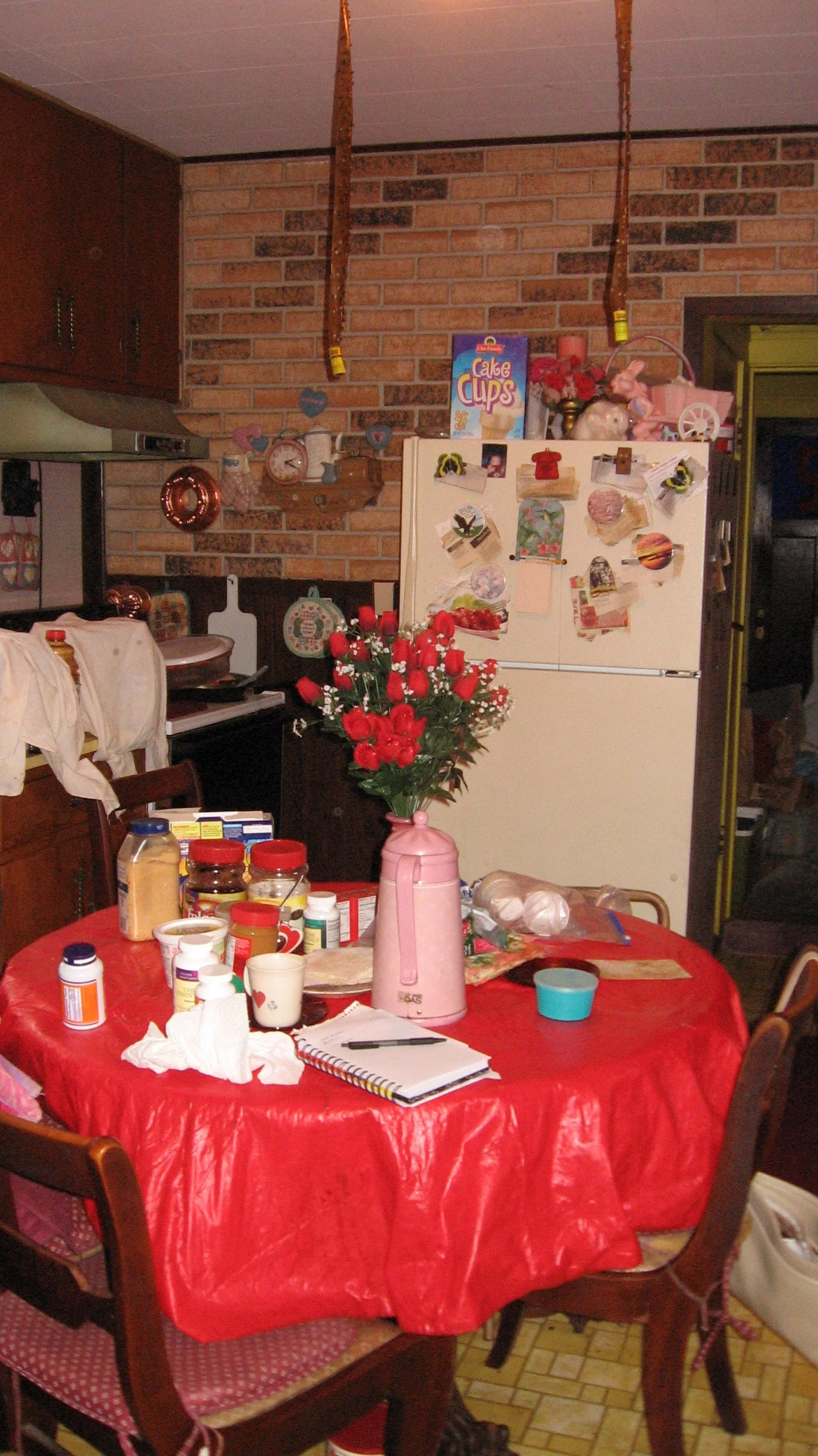
It was crowded with stale cookies, coffee cups and silk flowers in a vase. Nothing glaringly screamed “dangerous hoarding conditions.”
At least, not at first glance.
Let’s call my family member, “Hannah,” for privacy’s sake. Hannah withdrew from human contact after her husband’s death. Hence, the welfare check. She neglected her health and personal care needs. In fact, she stopped taking her blood pressure medication two weeks before her devastating health crisis. She was found lying on the floor for two days, unable to reach the phone.
As paramedics scrambled to maneuver the house’s hoard and attend to her, no one paid much attention to the kitchen table. Yet, that piece of furniture held much backstory about Hannah’s decision- making process and state of mind. Both were dangerously unhealthy.
As we cleared the table, the red tablecloth felt “padded.”
Removing it, we came to discover “layers” of tablecloths, covering the surface.
“From the end of the earth I will cry to You, When my heart is overwhelmed; Lead me to the rock that is higher than I.
Psalm 61:2
Tablecloth Layer #1: Bills:
We lifted the first red tablecloth and discovered its secrets.
Strewn throughout were various bills, both current and not so current. Some weren’t even opened. They had Hannah’s scrawled handwriting, on the envelopes, informing her that this bill arrived in 2003; this bill arrived in 2009. There were overdue bills, second notices, all requiring a complicated, tedious unravelling process. It took weeks to accomplish.
And it showed my family that Hannah was letting things go. Was is merely absent-minded? Or was it deliberate? After all, she didn’t pay- or even open- these bills. She simply covered everything up with a tablecloth. That was her solution?
Unfortunately, for the hoarder, that often appears to be a viable remedy to unpleasant realities. And bills, if nothing else, are unpleasant. This “symptom” signifies, oftentimes, how the hoarder can no longer be viewed as financially responsible. Guardians and financial powers of attorneys, therefore, need to step in now.
Hoarders may not utilize the tablecloth technique when it comes to bills. Some hoarders simply lose track of the mounds of accumulating paper. But there is a common disconnect:
“I don’t want to deal with this, so I won’t.”
Tablecloth Layer #2: Depression Denial
“From the end of the earth I will cry to You, When my heart is overwhelmed; Lead me to the rock that is higher than I.
Psalm 61:2
We pulled off another layer, this one pink. Packed sheets of notebook paper covered the table. The content of these pages contained Hannah’s written prayers asking for help with losing weight and meeting her “goals.” Sprinkled amongst her wish list were repeated mentions, “I’m depressed.”
And I immediately flashed to remembrances of her defiantly declaring, “I don’t need therapy. That’s for other people.”
This was a woman who endured abuse, trauma and severe poverty. But, not surprisingly, because of shame, she could not admit she needed help from anyone else besides “The Lord.”
She denied she was sad.
She denied she was depressed.
She denied there was a problem.
And, I guess, looking at her notebook entries, which abruptly stopped a year before her health crisis, she eventually denied there was a problem to even “The Good Lord.” She decided, again, to cover the table.
Hannah was suffering. Yet she was adamant about refusing help. She self-medicated instead with food and shopping, which, of course, exacerbated the hoarding.
What could have happened if she just received some professional counseling? What could have happened if she admitted she was miserable?
Tablecloth Layer #3: Dangerous Coping
“From the end of the earth I will cry to You, When my heart is overwhelmed; Lead me to the rock that is higher than I.
Psalm 61:2
The table still felt padded. We pulled off another layer (this one was floral).
The surface here was covered with various family members’ Social Security Numbers written on index cards and notes to herself about how to operate appliances and where she kept various “important things” that she was, I guess, afraid she’d lose track of.
Yet, with the event of her health crisis, the evidence was overwhelming. She had lost track of everything. A progression of mental fogginess was, perhaps explained by her massive stroke (or strokes)?
Hannah was disorganized and desperate, never wanting to admit to herself that her strategies to “get by” further jeopardized her life and safety. And her methods of staying on top of important pieces of information was, inevitably, only covered with another layer of tablecloth.
Hoarders often make notes to themselves, reminding them of important matters: people’s phone numbers, where the car keys are, how to operate the car, how to turn on a light or lock the front door. They believe these instructions will keep them safe. But these notes are often lost and buried somewhere. Their whereabouts, many times, is long forgotten.
Tablecloth Layer #4: The Sacred and the Meaningful
“From the end of the earth I will cry to You, When my heart is overwhelmed; Lead me to the rock that is higher than I.
Psalm 61:2
The padding on the table still existed. There was one more layer.
We removed the red and blue floral tablecloth to find scattered mementos: family photos and even the postcards my husband and I sent Hannah when we moved Westward…in 1999. It was shocking to see how these mementos were not in picture frames or even scrapbooks, for she insisted on keeping them. Hannah wouldn’t throw anything away.
Did these items mean anything to her? And, if they meant something, why did she bury them?
Perhaps, it was an all too common hoarding behavior: people bury their treasures, again, often forgetting where they buried them. The hoarder wants to keep not only his/her treasures safe, but himself/herself safe as well.
Hannah wanted to be safe. And she also wanted a clean house. Maybe she felt her tablecloth method achieved both. She could keep everything, yet still have things look pretty. Because, let’s not forget, on top of that first layer was a vase with silk flowers. She was trying for beauty.
Aesthetically pleasing, but at what price? Her health? Her safety? Her social life? Hannah didn’t let anyone “in.” She chose to shut out those people, representing those photographs and mementos. The biggest reasons? Probably shame and self-protection, which were both in overdrive. But what emotional damage did this do to not only her, but to others, as well? No man is an island.
Safekeeping. It appears to be a hallmark of a hoarder. Stay safe. Build a barrier. Build a cocoon. And somehow, over time, that morphs into a death trap. People have been found dead under the layers of cocooning, known as their homes. It’s private and quiet.
Usually, by the time the hoarding is discovered, it is at crisis level. It requires professional help of the “many hands” variety. It requires counseling. And that requires willingness from the hoarder. And if he/she is anything like Hannah, that will be a challenge, as they assert, “I don’t need help/therapy. I’m fine on my own.”
In fact, concerning the hoarding, the only way to effectively stop the madness was to remove her from that multi-room home and place her into a more contained care facility. Hannah is now limited to her bedroom. Facility staff frequently check on her, monitoring her hoarding tendencies so they do not flourish in this environment.
And sometimes, that is the best one can do. Hoarding is a compulsion, often born from trauma. You cannot reason with it. And it’s not as simple as “just get rid of the junk.” More will appear quickly in its absence.
Hoarding, from start to finish, is a layered issue. And we often must pick things apart, layer by layer, dealing with it.
“From the end of the earth I will cry to You, When my heart is overwhelmed; Lead me to the rock that is higher than I.
Psalm 61:2
Overwhelmed Heart.
It screams layers of overwhelm, doesn’t it?
You and I may not be hoarders.
But there is clutter in our souls, somewhere, somehow.
Our hearts are overwhelmed.
The Most High IS The Rock that is higher than us.
He and His Son, Yahshua, Our Savior, according to scripture, “are One” (John 10:30).
We are all a bit cluttered. Right here. Right now.
We need help getting cleaned up.
Let’s pray.
Abba Father-
We come to You, in The Name of Your Son, Our Savior, Yahshua.
You see our clutter. Our mess. Our disorder.
You know how we need Your cleansing and order in our lives.
Forgive us
Help us.
Do for us what we cannot do for ourselves.
Heal us.
Deal with our clutter, our hoarded sin and pain.
Make us new, clean, and restored.
We accept Your Son as our Savior, Your Redemption for our lives and souls.
We receive it all, with humility and gratitude.
Thank You.
In Yahshua’s Name, we pray.
Amen.
Copyright © 2025 by Sheryle Cruse
Conditioning
“Train up a child in the way he should go, And when he is old he will not depart from it.”
Proverbs 22:6
Daily, mundane routines can capture the deeper issues in our lives.
Like a lot of people out there, my hair has vexed me. Memories of snarls and pulling at my head, using “No More Tears” hair detangler certainly did not matters. And I never looked like the pretty, golden-haired little girl, enjoying the bonding experience with the beautiful, blonde mother, featured on the bottle.
I’ve spent the greater part of my life battling my hair. Hence, hair conditioner. And, as I’ve been battling my various OTHER issues, family dysfunction and abuse, being at the top of the list, I’ve recently seen how there is, indeed, a common denominator: conditioning, as the practiced tactic, and, as some would say, the “solution.”
A documentary on hair once espoused that the universal desire of people with hair problems is that they have a “manageable” coiffure.
Whether curly, wavy, straight, kinky, fine, coarse, long or short, people just don’t want to battle their hair all day long.
Therefore, hair conditioner promises to fix our woes. Check out what is declared on the bottles:
“To moisturize, nourish and protect.”
“Tames and smooths”
“Vibrant and beautiful!”
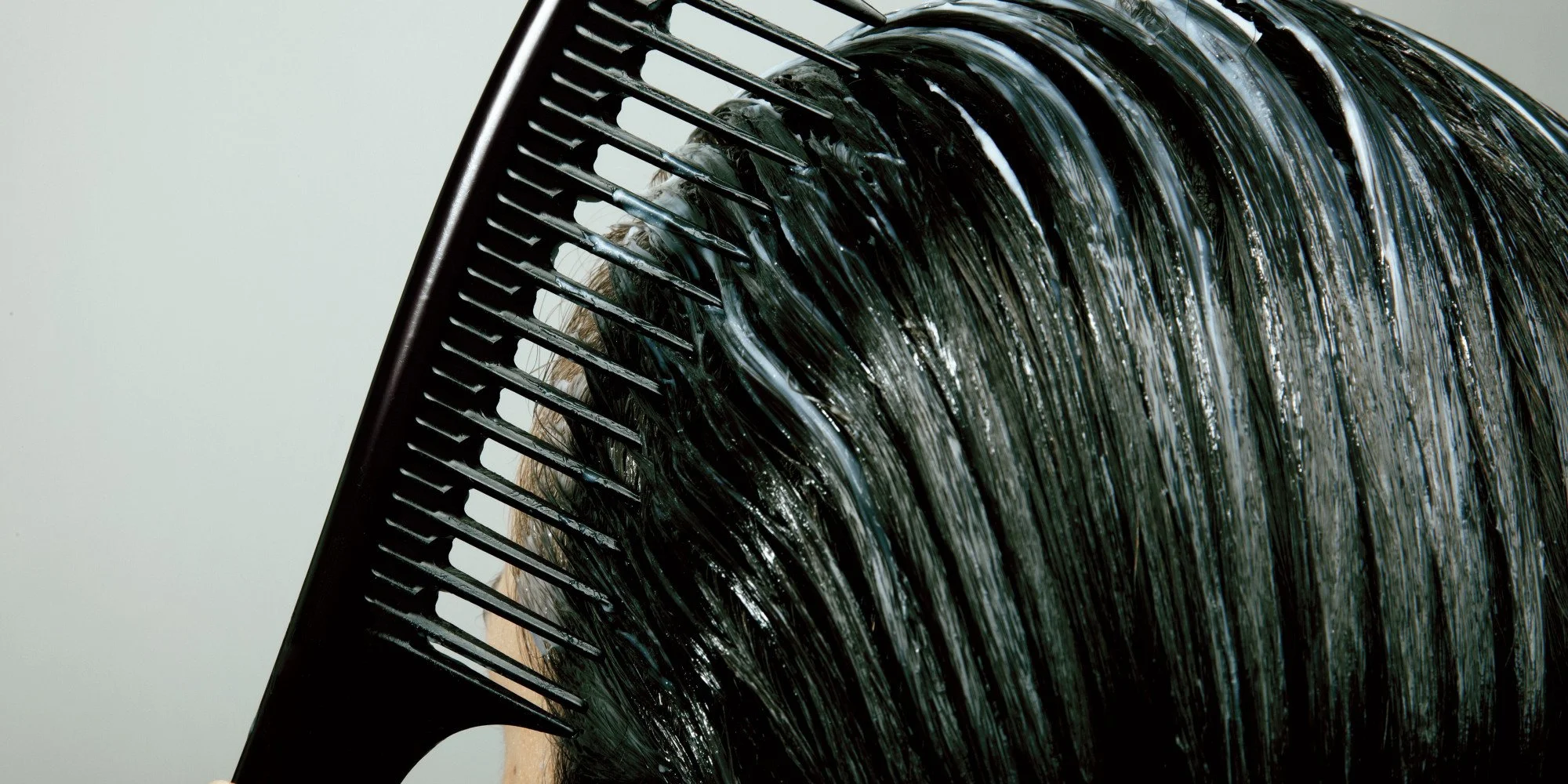
As I contemplated some of hair conditioner’s promises, I saw striking similarities to abusive dynamics.
Like many conditioners out there, abuse’s goals are often to…
Protect:
How many conditioners promise to protect the delicate strands of hair from harm, damage and breakage?
My life has been littered with bottles, assuring me that my snarl-prone ‘do would not suffer any further havoc. I was safe using this magic potion.
Aren’t we all promised safety with this haircare product? Indeed, ingredients like Biotin and Keratin are often offered to keep our manes in their full glories.
Abuse and dysfunction, likewise, in their deluded perspectives, also believe protection is happening, employing their own ingredients: manipulation, gaslighting, isolation, threats and misuses of money and power.
The emphasis is on the protection of the image, the reputation, the “system” the abuser has going on. Nothing can threaten that “status quo.” It must be protected, no matter what.
The abuser may say things like…
“…You don’t need to work and make money. I’ll take care of you…”
“…I just want it to be the two of us…”
“…You don’t need friends. You have me…”
The “protection” ensures no outsider can peek into the reality, which is often shame and secret-ridden and physically, emotionally and mentally harmful. Protection from outside critiques or influences, therefore, must be prevented and destroyed. Abuse is the only world allowed to flourish.
Smooth Things:
Conditioners often tout their ability to make one’s hair the ultimate in silky smoothness.
I have a slight natural wave that gets feisty with humidity.
And I live in a place rife with humidity.
Therefore, some smooth silky reality would be nice to, again, keep things manageable on top of my head.
Here’s where ingredients like Argan and Coconut Oil are presented as the must-have solutions to hair woes. The focus is on de-emphasizing “unruly” curls, waves and, of course, the dreaded “frizz.”
Beat that hair into submission.
And, once again, the abuser’s playbook has some similar motives and strategies: to keep the peace at all cost. Make things look more “pleasing” than what they are.
“Smoothing out” things, in an abuse context, may look like this…
…Convincing institutions like houses of worship, schools and court systems that there is some “misunderstanding,” usually because the person being abused is presented as “crazy, troubled, sick” and, therefore, needs the abuser to look after him or her…
…Lying, just outright lying. The abuser knows the truth is against him/her. So, building a Machiavellian case, with any ends justifying any means, is necessary. Lying, using charm and, yes, smoothing any circumstance is implemented to prevent and stop an outsider from asking some inconvenient questions…
…Bribing and bartering. Yes, really. A deal, that was “too good to be true” was promised, one often involving- quelle surprise- large amounts of money and, just like that, the person gets sold out. Yes, indeed, deals do get made, secret deals. When an abuser is involved, opportunistic schemes can abound…
Control Things:
Conditioner promises us the illusive guarantee of complete and perfect control.
These products claim to correct and alter our hair shafts, paving the way for perfect hair.
Again, whatever unruly and undesirable state of hair you and I are enduring, there still seems to be this unrealistic expectation that we will reach perfection with it.
So, we apply the conditioning.
Abuse is similar also, in this respect. It is all about keeping things contained. Just like the other mechanisms of conditioning, there is emphasis on keeping something or someone from doing something outside of the bounds of the abuser’s permission and altering another individual’s life.
Such as…
“…Trapping” the victim: in example: taking his/her car keys, relocating the person to an isolated area, monitoring their phone usage…
…Limiting the individual’s choices: their appearance, what they eat, how they dress, what they say, their interactions with family and friends…
“…Convincing” them that they need to live like this. If they deviate from this premise, they are shamed-conditioned- to believe they are wrong, at fault, defective, ungrateful, stupid, crazy or “not good enough” in any way…
Weighed Down:
Here’s a lesson I learned, early on, about hair conditioner. Despite its many promises, it can weigh your locks down. Over the years, I have tried to have smooth, sleek, manageable hair, only to achieve a limp, stringy result.
Too much conditioning? Too much manipulation of my hair when I should have just shampooed it and gotten on with my life?
Still, with all seriousness, as we look at conditioning within the context of abuse, we can also get weighed down, far too quickly, easily and thoroughly.
One can argue that abuse takes a lifetime from which to recover. The conditioning leaves its mark. It leaves us automatically responding to life with maladaptive behaviors that, if we had not been “conditioned,” perhaps, we would have freed us to make healthier choices. It’s an endless, demoralizing rabbit hole to descend into.
Nevertheless, here we are, in whatever condition we are.
Conditioning is all about manipulation. It can be hair; it can be a human being.
The challenge that we face, as we recognize its subtle handywork, indeed, is to reconcile and heal our condition: soul, mind, psyche.
The Most High specializes IN that reconciliation and healing.
“…‘I have heard your prayer; I have seen your tears. I will surely heal you.’”
2 Kings 20:5
Yahshua.
His Son. Our Savior. He paid the price…
“But He was wounded for our transgressions, He was bruised for our iniquities; The chastisement for our peace was upon Him, And by His stripes we are healed.”
Isaiah 53:5
How are you conditioned? What abuses and wounds did you experience?
Let’s pray. Let’s go to Our Savior, asking Him for healing right now.
Yahshua,
We come to You.
You know how desperately we need You.
You know our wounds.
You know how we have been conditioned to be abused and mistreated.
Thank You for dying for us. Thank You for being wounded for our sakes.
Be Our Savior, be in control of our lives, from here on out, including every harmful kind of conditioning and wounding.
Hael us. Bind us up with Your Restoration and Real, Loving Presence.
Thank You for touching and healing us now.
We receive it, by faith, now.
Amen.
Copyright © 2025 by Sheryle Cruse
Fool’s Gold
“In all labor there is profit, But idle chatter leads only to poverty.”
Proverbs 14:23
For many years, my family kept this hunk of shininess here, thinking there was a chance it could be the real thing.
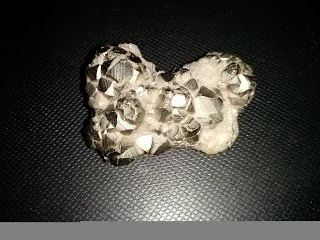
There existed hope that, yes, indeed, they struck gold!
Now, I have inherited this hunk of shininess, only to discover it was, in fact, “Fool’s Gold.”
As I’ve learned more about Narcissistic abuse, I’ve discovered one of its most important tactics: “future faking.”
A future faker uses promises, inferences, and intensity to simulate intimacy and to keep control of a relationship or a situation.
Indeed, I have repeatedly experienced “future faking,” although I didn’t know what to call it. It’s sanity-saving to recognize that what I went through had a name.
“In all labor there is profit, But idle chatter leads only to poverty.”
Proverbs 14:23
Scripture mentions the poverty destination to “idle chatter.”
Yes, I see how “future faking” can lead to the destitute place.
“Someday…”
A large component of my personal experience with emotional fool’s gold or “future faking,” involved the use of this word. Such hope and promise were contained within it. The assurance that, no matter what hell or pain someone goes through, “it will all be worth it…someday.” I noticed that, while the persons and circumstances of my experiences may have changed, that “someday” element was consistent throughout.
Future Faking: Just Be Good Enough:
Alright, let’s start from the beginning.
Being anything, “enough” was at the epicenter of the “someday”/ future faking promise. The dangled carrot of “If you’ll just be or do this, then you can have this reward” was way more dysfunctional than any goal setting. This was all about conditional love, worth, and acceptance. I learned I could not possess any of those things unless and until I met the proper specifications. Most of the time, the rules were never clearly and fully declared; it was the insecurity of never quite knowing where you stood.
But keep striving, because, after all, “someday…”
The first few times I tried for glittering, someday prizes, things seemed shiny, innocent, even fair. Yeah, of course I needed to try for these things. They don’t just come automatically.
But gradually, as I performed and completed tasks, missions and behaviors, with no promised reward to show for it, I started seeing how the goal posts just kept moving.
Achieve this. Okay, achieved.
Now just achieve some more. Okay, done.
More movement of the goal posts.
And it never stopped. It quickly set in how this was a game I could never win. I could never be “enough” at anything, because the “enough ante” was always upped.
Future Faking: Someday, They’ll Die:
So, learning that lesson as a behavior baseline, I was now old enough, ready enough to be taught some finer points. Morbid, macabre points.
Coming from an abusive dynamic, it was inevitable, I suppose, that certain family members would come to view death as the surefire escape of the hellish existence. Yes, there were suicidal thoughts and even attempts. But it went further than that. Certain individuals would, in fact, make “someday” promises to me, like “someday, when this person dies, we’ll be able to do whatever we want.”
So, as a child, I looked at that person’s death as that hope for better days.
I know. It sounds adorable.
But, surrounded by adults who were supposed to “know better,” what else was I supposed to ascertain from the message?
“When this person dies, we’ll be able to do whatever we want.”
That’s quite a powerful promise.
And that statement laid groundwork for other mistaken beliefs to be taught:
Future Faking: Someday, We’ll Be Able to Do What We Want:
This included some dream career, which further promised “happily ever after,” and worldwide traveling. Underscoring everything, in the subtext, was the even more vague, but gleaming promise: “We’ll be happy.”
So, as a child, navigating abuse, I waited with this adult who promised the happiness and perfection that hinged on another person’s death.
We waited for years… decades.
Inevitably one day, some twenty-five years after this promise was given to me, yes, this person did die.
And there was no radical transformation, at least, not of the happy, “we-can-do-whatever-we-want” variety. There was no perfect dream career. There was no perfect international travel.
There was just unrealistic expectation and spent energy, funneled into the “someday.”
And, as I watched and learned all about the disillusionment from this trusted adult, who was supposed to know more than I did, have the answers and make them actualized, I learned another dysfunctional lesson: I better get to work and achieve, already!
Back to the salt mines. And maybe, this time, I’ll get what I want.
Future Faking: Achievement:
I became an overachiever, yes. I’d seen what stagnation produced. I’d seen the disappointment faces on adults as they waited for an answer to materialize that didn’t. I saw how passive inaction led to nowhere, nowhere I wanted to go, anyway.
So, action, achievement, performance, awards, accolades, striving. That was the name of the game now. This time will be different. The goal posts won’t move. I’ll successfully achieve.
I was the cliché overachieving kid, winning good grades, awards, ribbons, and trophies. I did this, with the hope that the designated prize of the moment would finally seal the deal: I was enough; I did enough.
But those moving goal posts again.
It wasn’t long before grade school turned into high school, which turned into college, which turned into adulthood, with me still chasing.
And even though I may have “won” something: attention, an award, some achievement, a coveted relationship, the insidious lies of future faking were still not quelled.
“Just Be Good Enough,” “You’ll Get My Love and Approval,” “You’ll Get Promoted” still existed, just out of my reach.
I chased and “hung in there,” believing If I just sacrificed myself enough, exhausted myself enough, then, certainly, the golden promise would be mine.
It would not be Fool’s Gold. It would be the real thing.
It kept me humiliating myself in harmful relationships, as I convinced myself they’d love and accept me if I changed in a certain way.
It kept me expending energy, time, effort, and resources because I believed somehow “this time, it’ll work.”
It kept me waiting, waiting for some illusive perfection that would make up for all pain.
It was just a matter of time, after all. “Someday…”
Meanwhile, I learned about what it’s like to live manipulated, used and discarded, as not only other persons exploited me for their own purposes, but I did that, as well, to myself.
Sadist…meet masochist.
What was going on here?
As an adult, wasn’t I supposed to know better? So, why wasn’t I doing better?
Because I still believed the Fool’s Gold was its actual 24 Karat, much more promising, cousin.
And it was never going to be that.
All it was, instead, was shiny illusion. Manipulative promise. Toxic hope.
It was my volunteering to wait, seemingly forever, in a mirage. No refreshing water, only desert.
I was choosing to do that. The Future Faking had no time restriction on it. It didn’t suddenly expire when I turned eighteen. It wasn’t restricted to childhood innocence and other people’s behaviors.
Future Faking, waiting on some form of toxic hope, was now something I had knowledge about. And I could choose to accept or reject its frustrating terms.
Future Faking: The Promise of Fool’s Gold:
Believing in the hope of “when” can, indeed, be Fool’s Gold.
It’s further exacerbated if/when we give our power away to a faulty promise. Sometimes, that’s at the hands of an abuser. Sometimes, that’s simply our own unmet needs running amuck, desperate for some cure-all to make all the pain go away. We become our own abuser.
Future Faking, with its shiny allure, can place demands on unrealistic “happily ever after.” It can keep us hanging on, staying in abuse, tolerating our devaluation, stunting our personal growth, living in pain.
We tell ourselves, “I just need to hang in there, because, after all, someday, it will be worth it.”
And it rarely is.
When we compromise our characters, our health, our well-being, our autonomy, or any other thing that is precious to us, with the hope that Fool’s Gold, will, in fact, become real gold to us, we are ones left dull and lifeless.
If it feels like someone is using the hope of “future faking” to keep you controlled and staying put, in any context, if it feels like you can never be good enough, do enough, please enough, be enough, that’s abusive. If it is us who are self-imposing this, that, too, is abusive.
Elohim is for us, not against us.
Life, love, and personal goals are never meant to be unreachable, ever-moving targets.
“For He performs what is appointed for me, And many such things are with Him.”
Job 23:14
Neither is Faith. Faith is NOT “future faking.”
And it is not our relationship with Our Abba Father…
“Fear not, little flock; for it is your Father's good pleasure to give you the kingdom.”
Luke 12:32
Pursuing life and future, via The Most High, in a healthy way, is our true treasure.
His Promise flourishes even within the imperfect process of accepting unflinching truth of who, what, when, where and how we are.
“My times are in Your hand; Deliver me from the hand of my enemies, And from those who persecute me.”
Psalm 31:15
Each of us can embrace that today.
It’s Gold.
Copyright © 2025 by Sheryle Cruse
Jabez Prayer or Bust!
The Jabez Prayer still influences me.
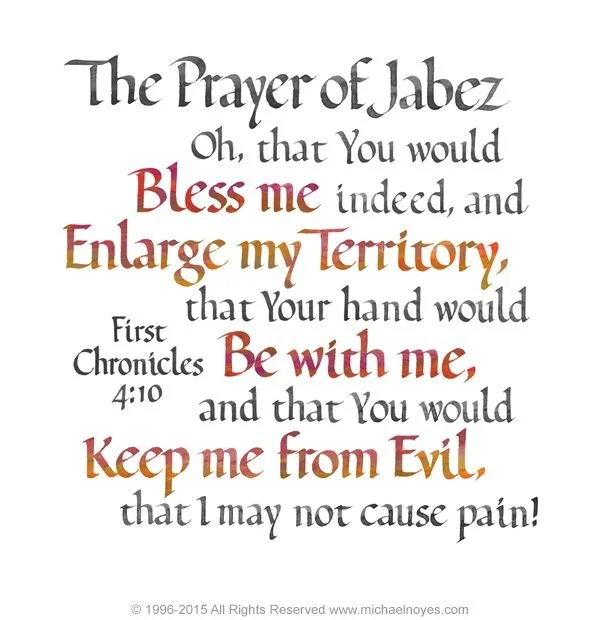
This prayer swept the Christian publishing world years ago.

Workbooks and seminars were created to explore its attributes.
For those unfamiliar with the scripture, it’s a tiny little marvel, lost in what is not exactly the most exciting book of the Bible: 1 Chronicles 4, documenting Judah and Israel’s history. The little ditty goes like this…
“Now Jabez was more honorable than his brothers. His mother had named him ‘Jabez,’ saying, ‘Because I bore him in pain.’ And Jabez called on the God (YAH) of Israel, saying, ‘Oh that thou would bless me indeed, and enlarge my territory, and that thine hand might be with me, and that thou would keep me from evil, that I may not cause pain!’ And (YAH) God granted him that which he requested.
1 Chronicles 4:9-10
Now, before I’ve completely lost you in this Bible-y context, let’s just stop briefly and examine this prayer’s bullet points, in a more human framework.
Indeed, post- cancer diagnosis, I started viewing the prayer through this imperfect lens. It has become even more personal and, dare I say it, relevant.
Let’s break it down a little.
“Now Jabez was more honorable than his brothers. His mother had named him ‘Jabez,’ saying, ‘Because I bore him in pain...’
Okay, so we’re off to a fantastic start.
Names tell us a lot about a person. And it’s not confidence-instilling to be presented to the world as “Pain.”
We need to tackle first the ugliness of our origin story, even if/when pain is its central character. Breast cancer shoved me headlong into the reality of my past. I could no longer avoid it, especially as now, this dreaded diagnosis embodied fulfilled pain for me. No more dancing around it.
…And Jabez called on the God (YAH) of Israel, saying, ‘Oh that thou would bless me indeed, and enlarge my territory…
We need to call for help. There’s no passivity when it comes to crisis moments.
And, underscoring that, we need to decide, what do we want? To be blessed or not? It’s not such an easy question to answer. How many of us self-sabotage? How many of us are sadistic with ourselves? How many of us think that we deserve pain and curses?
Yeah.
This part of the prayer not only calls a deeper 911, it confronts who we are and how we live.
Years ago, when I first encountered the Jabez Prayer, I saw it as the “gimme gimme” loophole to beg the Divine for my goodies. And those goodies included an enlarged territory of acceptance and acclaim.
But now, post-diagnosis, I see it differently. It’s about loving and accepting my own self-terrain. For as much external love, praise and applause out there, it means nothing if I cannot experience it within myself. I need to become more adept at self-love, self-compassion, and yes, the infamous word, self-esteem.
I need HELP enlarging that territory indeed! How about you? Can you say the same?
…and that thine hand might be with me…
My past experiences taught me there was a malevolent force, not a loving one, ushering me into life circumstances and dictating outcomes. How many of us only see a wrathful version of The Most High?
Part of my healing now, post-diagnosis, is to allow for Him to guide me. Again, it all sounds so simple. But this is hard work. It involves trust in something beyond the finite human self. Meaning, personally, me.
That is scary. It’s not about being naïve or stupid. It’s not about forsaking our own sense of responsibility for our choices. It’s about allowing for more. More can exist, without giving detailed explanations or soothing reassurances. A first step to experiencing the benefits of that “more presence…” is to ASK for it.
…and that thou would keep me from evil…
Further piggybacking that sentiment, we can make the choice to ask to be protected. We can make this request of ourselves. We don’t need to be subjected to harm.
We can make another choice. And part of making that different choice is that we allow protection from our own malevolent intentions and actions. We can be our own worst enemies. The cliché is true.
What are we willing to do with that?
…that I may not cause pain!’…
Accurate self-assessment and personal responsibility are central themes to this part of the prayer. Again, many of us can often have distorted definitions of what constitutes “our fault,” versus what we should be accountable for. It’s tricky.
But we do have an inner knowing about right and wrong. It goes beyond religion. You and I know when we have crossed a line. With that knowing, however, human beings are far too adept at creating pain. No matter how nice or loving or sweet we claim to be, that reality humbles us.
Perhaps, for everyone and everything we have the potential to help and heal, we also have the potential to harm.
Therefore, we need an accurate assessment of ourselves, even while we pray any altruistic or desperate prayer. We have not transcended being imperfect and all the wreckage that can come with that state of human being. But we are not responsible for every evil, either. We’re in the murky middle.
…And (YAH) God granted him that which he requested.”
Here is probably the most concentrated “Bible-y” point of the Jabez Prayer: The Most High. Elohim. Lightning rod. Controversial statement. Conjectures, debates, maybe even bar fights abound because of this point.
“I don’t believe in God.”
“This isn’t the ‘right” or the ‘true’ God.”
“There’s no such thing as God.”
“It’s all just a con job.”
I still see through this spiritual looking glass darkly, at best (1 Corinthians 13:12).
No one has the exacting answers. And here is where the “F-Word” usually gets trotted out: Faith.
Faith is an infuriating concept, because, after all, I want to KNOW!!! I WANT ANSWERS!!! I demand to speak to the Holy manager already!
But all that I’m left with is getting “Ma’am-ed” to Kingdom Come.
Faith declares that we don’t know for certain.
How very dissatisfying!
Still our spirit, soul, inner and instinct yearn and reach for something beyond finite, tangible answers. There has to be something to that, right?
My cancer diagnosis has got me reaching. And yet, even, slamming down my “Cancer Card” hard doesn’t qualify me for all answers, all certainty.
But it is possible that I am being granted all that I seek, in-process, right now.
In messy, imperfect, frustrating process, I am my own interpretation of Jabez. A well-known scripture, cited ad nauseum, admonishes us to “ask, seek, knock.”
Isn’t that we are doing, somehow, someway?
Even in the most content and complacent of us, we still want something more?
Jabez is about wanting more.
It’s not greed. It’s human need, the essence and the dignity of humanity. We don’t need to apologize for or be ashamed of that.
I apply the prayer, in earnest.
I await and engage in the results from- and because of-it.
Copyright © 2025 by Sheryle Cruse
Bouncers and Nope Cats
“But I am poor and needy; Yet (Elohim) the LORD thinks upon me. You are my help and my deliverer; Do not delay, O my (YAH) God.”
Psalm 40:17
I can’t get in. I’m out in the cold. No matter how hard I try, the situation doesn’t change.
Perhaps, you’re like Kitty here.

See yourself shoved into a corner, with no affirming view, other than the wall?
Is your life currently one big, fluffy Nope Cat?
“Some days are sulky. Some days have a grin. And some days are bouncers that won’t let you in.”
U2, “Some Days are Better Than Others”
Those lyrics have become front and center for me, especially lately. Especially when Cancer and caregiving had pressed my face to many walls, with no seeming way of escape. I’d wake up, having an important “to-do” list, motivated and inspired to only encounter the bouncer du jour, who decimated my mindset. Sometimes, it was fatigue.
My 2017 diagnosis, surgery, and radiation, indeed, ushered me into a brand- new experience of the word, “tired.” Bad reports and/or fear and anxiety over medical tests also slammed the door shut on me. I couldn’t concentrate on breathing, let alone, on “getting stuff done.”
And then there was my mother.
Oh, man. Where do I start?
Enmeshed mother-daughter issues? Her increased fogginess?
I had many Nope Cat instances, just hoping the bouncer that would not let me in for that particular circumstance would also not beat me to a bloody pulp.
It’s great to have aspirations.
It has been almost a year, now, since her passing. I have a bit of perspective, looking back. I see bouncers and “nope cats” in a different way now.
So, what do we do when we get bounced?
I have learned a few strategies.
Write.
I don’t have to be Shakespeare or Stephen King (although they both were great at conveying grisly drama). I just must express myself.
Bad spelling, punctuation, mess, it doesn’t matter. Get it out of my system however I need to.
So, that may mean some truly horrendous poetry. That may mean I just stab the paper with an ink pen. Whatever works. Really. Whatever works.
In the case of my mother and my diagnosis, I’ve written some scathing stuff directed at them both. Just let it rip. And then, after I was done with my rampage, I destroyed it, via my paper shredder.
I do this as tangible proof to both my conscious and my unconscious mind that I have done something. I don’t know the details of how the brain works. But I do know I have taken action. Screaming, stabbing, shredding, bad writing action, but action, all the same.
“For as the body without the spirit is dead, so faith without works is dead also.”
James 2:26
I have dealt with that particular bouncer and my Nope Cat growls with satisfaction, not frustration.
So yes, whatever you’re struggling with, whatever is preventing you from gaining entry into life for that certain situation, get it out of your mind and onto paper.
Read.
It sounds cliché, but reading helps the human being’s mind.
And, yes, speaking of minds, sometimes, it’s helpful to get out of ours for a while and into someone else’s. Novels, classic literature, self-help, memoirs, comic books (a/k/a, graphic novels for you connoisseurs), or even, Dr. Seuss- it doesn’t matter.
The weekend before I received my biopsy results that yes, indicated I had Breast cancer, I was absorbed in Mayte Garcia’s autobiography, “The Most Beautiful: My Life with Prince.”
I’m a Prince fan and from Minnesota, like the superstar, so, I was naturally engrossed in learning what is what like to be the Purple One’s Beloved. The book was juicy, with romance, love, drama and yes, tragedy. And it took me out of my “Do-I-have-cancer-and-am-I going-to-die” thoughts. I still needed to face my biopsy results after the weekend was over, but, for that “time being,” it was all about great love, great sexiness and great loss. My bouncer and Nope Cat were tinged purple.
Likewise, if you’re going through it, bounced out of a day, a week, a month, or any epic era in your life, transport yourself however you need to...and read.
And I wouldn’t be a responsible person of faith if I didn’t mention how reading Scripture can help with stifling Bouncers and Nope Cats.
“So shall My word be that goes forth from My mouth; It shall not return to Me void, But it shall accomplish what I please, And it shall prosper in the thing for which I sent it.”
Isaiah 55:11
The Word of The Most High works; it will not fail!
Pray.
“Pray without ceasing.”
1 Thessalonians 5:17
It’s not about “Thee’s” and “Thou’s.”
It’s not about using the King’s English.
No.
Prayer is that visceral connection to Our Creator. We didn’t just hatch on our own, after all.
Prayer has gotten a bad rap. It can be viewed as irrelevant, impotent, and foolish. It’s also been a tool to shame and intimidate us. We just aren’t “good enough” to pray and seriously expect our prayers to be answered. We’ve sinned too much, screwed up too much. We’re not cultured or well-versed enough to access it.
“Go back to your dank, hopeless hole, then, you peasant.”
Something like that.
I’ve prayed most of my life. And, most of my prayers were not of the noble, erudite or selfless variety. The ongoing reality of my cancer diagnosis (what it is, what it could turn into, what I fear), yep, my prayers do not employ the King’s English.
“Pray in the Spirit at all times, with every kind of prayer and petition. To this end, stay alert with all perseverance in your prayers for all the saints.”
Ephesians 6:18
I mainly use these two words instead: “Look” and “Help!”
“Look…”
When I’m not in an immediately urgent state, just dissatisfied on some personal issue, I usually start my prayers with this word. It’s a preface; it lays my complaining groundwork.
Yes, I’m a complainer.
But, concerning humanity, I mean, gritty humanity, aren’t we all?
Leave Pollyanna to Hayley Mills!

The rest of us must deal with the real world.
So, I just lay it all out there, unvarnished, whiny, but true. Why mess with dishonesty here, after all? That’d be pointless.
“Help!”
Not just a Beatles’ song, Folks.
When I need to cut to the chase, this is my prayer.
I’m in danger; I’m in despair.
Cancer often fits the bill concerning both. I need a lot of help these days. Preventing myself from sinking into depression, noticing a weird symptom that, yes, could be cancer all over again, feeling alone and disconnected- all areas necessitating a “Help” prayer.
“My times are in Your hand; Deliver me from the hand of my enemies, And from those who persecute me.”
Psalm 31:15
And after I’ve gotten out of a jam, I do try to say another prayer: “Thank you.”
“Therefore I exhort first of all that supplications, prayers, intercessions, and giving of thanks be made for all men.”
1 Timothy 2:1
But I’m mortal.
And so, sometimes, unfortunately, I’m quite a rude little thing. And that requires a whole ‘nother prayer: “Forgive me.”
“If we confess our sins, He is faithful and just to forgive us our sins and to cleanse us from all unrighteousness.”
1 John 1:9
If you find yourself leaning toward saying a prayer, using any old string of sincere pleas, go with it. Don’t fight it. The Most High IS listening.
To the bouncer and to the Nope Cat here, I say, Amen.
Cry. (Or whimper. Yowl. Howl. Sob. Sniffle. Take your pick).
“... ‘I have heard thy prayer, I have seen thy tears: behold, I will heal thee...”
2 Kings 20:5
My own personal dam breaks on a regular basis.
Once upon a time, I could keep it together.
I could hold back tears. I could power through, being stoic.
No more.
Now I cry.
It’s not unheard of for it to happen on practically a daily basis. Bleak cancer situations. Bleak grief. Bleak, I’m a woman, imperfectly living an imperfect life.
I ping-pong from issue to issue: fear, obligation, guilt, frustration, loss.
You know, like the rest of us out there. It can be too much.
And, since my diagnosis, there has been a raw intensity to issues, emotions, and life. It’s Technicolor, but without Bugs Bunny.
And so, I let it out. To deny my real, raw, intense feelings is to possibly sprout a recurrence. If I don’t get it out now, it could poison me.
So, I cry, bawl, weep, whimper, sniffle, whine, wail. I do it all. Whenever. Wherever. I try not to do it in public so much, but still, sometimes, the dam breaks. Take that, you bouncer. My Nope Cat needs a hanky.
And, Sweet Soul, if you, likewise, need to address your bouncers and Nope Cats with some boo-hoos, please do. We are feeling beings. And feeling beings cry.
“They that sow in tears shall reap in joy.”
Psalms 126:5
Rest.
“He makes me to lie down in green pastures; He leads me beside the still waters.”
Psalm 23:2
Bouncers and Nope Cats can be exhausting. They challenge our self-worth and pull energy from us, as we struggle to adjust, heal and soothe ourselves. Yet, how rarely do we actually rest from all of this taxing work?
Just like being in charge of an actual child, including their nap times, we need to make sure that we, children of The Most High, recharge.
We cannot just go-go-go.
We will hit a wall, sometimes, literally. As the children we inherently are, indeed, a strawberry jam-filled, sticky fist print may be smeared on a surface, somewhere, as we finally give way to a temper tantrum, overtired, and shrieking.
Come on. You’ve been there; I’ve been there. But I personally prefer cherry preserves.
However, now, my cancer diagnosis, in particular, grabbed and admonished me, “Pay attention! Rest, Little One!”
So, yes, I must consciously make myself aware, I have to consciously practice this statement AND behavior: “I give myself permission to rest.”
More to the point, He makes me rest.
And that goes beyond nigh-nigh time. Sleep is important; I make it a priority.
But rest incorporates other things as well.
I walk away from a person or a situation that doesn’t work for me; sometimes, I leave a conversation. To do otherwise is to invite a drain that is quite detrimental to me. It’s detrimental to any single one of us. And we need to give ourselves permission to step away from disease-causing stimulus.
And sometimes, rest includes being done with a particularly challenging circumstance.
There is a character from “The Lego Movie:”
Uni-kitty.
Part pink cat, part unicorn, all block-y Lego. In the animated film, she interacts with the other characters as a sweet and innocent cat face smiling as the adventures unfurl.
But, inevitably, Uni-kitty reaches her breaking point, fed up with playing nice and in an outburst, exclaims, “Ah, forget it!!!”
She then explodes into a red, furious version of herself and startles everyone in the process.

Mama means business.
Rest sometimes means you have to be done.
Be done with being mistreated and abused in a relationship. Be done with a frustrating behavior. Be done forcing yourself to “achieve” some impossible standard.
Sometimes, in order to rest, you and I have to say, “Ah, forget it!!!”
To the bouncer and to the Nope Cat circumstances, I say, “Behold, the wrath of Uni-kitty!”
Again, whatever works.
“‘Fear not, for I am with you; Be not dismayed, for I am your God. I will strengthen you, Yes, I will help you, I will uphold you with My righteous right hand.’”
Isaiah 41:10
Bouncers and Nope Cats happen to us all.
Even when everyone and everything else, seemingly, says “no” to us, we can make the choice to answer our lives with “yes.”
We can turn to Him, “the Author and Finisher of our Faith” (Hebrews 12:2).
No Nope Cat or Bouncer can go against that.
Copyright © 2025 by Sheryle Cruse
Believe the Wounding
Abuse is insidious, taking many shapes, including physical, sexual, verbal, emotional, mental, financial, legal, and spiritual expressions. All are damaging. There is more than one kind of wound.
“Death and life are in the power of the tongue, And those who love it will eat its fruit.”
Proverbs 18:21
Growing up, I experienced verbal, mental and emotional abuse. That was bad enough. However, the secrecy, shame and the reality that I have often not been believed for my experiences have been just as painful, if not more so, than the initial abuse itself.

Physical abuse has existed within my family. However, I only heard of encounters secondhand, but those secondhand accounts were traumatizing, nonetheless. Certain family members used threats, control and lastly, physical violence to make a point. Male figures hit their female counterparts on the head with hammers and, of course, their fists.
Not surprisingly, unfortunately, the abusers were not arrested. The family, the church, and the community protected the abusers by believing them instead of the victims. There was nothing to be done except “mind your own business.”
I directly experienced emotional/mental abuse within that toxic mentality. And it had its own harmful effects. One of them was being believed for that abusive reality, which was difficult to achieve. After all, there were no bruises; there were no visible marks.
Therefore, I’ve been in positions in which I had to “prove” that what I experienced was, in fact, abuse and was, in fact, damaging, even though I was never physically struck. Verbal, emotional and mental beatdowns, in some peoples’ minds, didn’t seem to count.
And again, family and the community, too often, rallied around the abuser, defending that person with fervent conviction.
But I was still harmed. Beginning in childhood and resurfacing in some of my encounters as an adult, the abuse experiences I lived instilled a “fear of God,” worst-case scenario as a normal baseline in my being. I learned to fear in that corrosive atmosphere. Power inequity, threats, name calling, humiliation, intimidation, and deceit were all just business as usual.
Constant rumblings of perpetual danger, constant messages of needing to keep the peace “or else,” imprinted toxicity into my childhood. I learned this was the way I needed to approach the world. Every interaction required hypervigilance. Every person was a person I needed to please, in order to avoid trouble. I learned silence about reality was mandatory. Family image was more prioritized than truth.
I learned no one would believe me over my more powerful abuser.
I learned emotions weren’t safe.
I learned how to make something pretty on the outside, no matter how ugly or painful it is on the inside. Keep quiet; don’t tell. Be unheard. Continue to walk on those eggshells.
And verbal abuse, inevitably, went along with that.
Who Told/Taught You That?
“You’re never going to amount to anything!”
“You can’t do anything right!”
“You’re so stupid!”
“You’ll never change!”
“You’re no good!”
I heard these statements daily. No, there were not any fists hitting me, but the words were weapon enough.
Because there was an inequity of power (I, especially as a child, had none), I could not defend myself against the daily onslaught of demoralizing statements. They were uttered by adults and authority figures who were not to be challenged or confronted.
The Argument I Couldn’t Win:
The hopelessness was debilitating, because how could I prevail over an adult telling me that I will be nothing, that I am good for nothing? But further injury occurred, as I turned to get help.
I was met with minimization and told me it wasn’t as bad as I thought it was. Being yelled at and told that I wasn’t going to amount to anything was not a life or death issue. It was just something I had to deal with, that’s all.
Individuals who said these things were often coming from their own physical abuse situations.
So, to them, I suppose, verbal/emotional abuse wasn’t so awful. These individuals were convinced if I would just “try a little harder,” things would be different.
“It’s just words; it’s not that bad.”
And so, I did try harder. It manifested in things like eating disorders, perfectionism and constant anxiety.
Words do create.
And abusive words don’t always have to be the most hateful, venomous insults, either. Sometimes, they can include the word, “love,” but the abuser will distort it for his/her own agendas.
You and I may, indeed, hear, “I love you” from an abuser. But it’s not unconditional love; it has “strings.” It involves some transaction or performance on our part to “earn” and “keep” that love. Pleasing the abuser achieves the love; displeasing disqualifies us from it.
And, there are also too many of us who have never heard the statement, “I love you” from an abuser. Abusive words can take the form of words of omission. Our abuser may withhold, again, to achieve a certain agenda, power or purpose.
We ache to be loved as human beings. Therefore, if we feel that love is “just out of reach,” unattainable or even nonexistent, we learn wrong things about ourselves, about healthy relationships and about life itself.
Yes, It Is Abuse!
And then, there’s another kind of abuse, the disbelief…
You and I can encounter this form of abuse as we share our experiences. Again, we can tell a supposedly “trusted” family member, friend, teacher, coach, co-worker, doctor, attorney or member of the clergy or the police about our plight.
And, instead of getting support and help, we get accused and punished. We get doubt about what we’ve experienced.
(Uttered about our abuser) “I just love ______. He/she is SOOO nice, sweet, funny…”
“You’re being dramatic.”
“At least you weren’t beaten.”
“Unless he/she was arrested for it, you can’t prove it happened.”
It’s all too common with any reports of violence: abuse, rape, sexual harassment. The MeToo Movement may help with some of that harmful disbelief.
But still, too often the burden is upon the abused person to prove heinous things are done. We are not given the benefit of the doubt. Unfortunately, many times, the only person who experiences that benefit is the abuser.
“It would be better for him if a millstone were hung around his neck, and he were thrown into the sea, than that he should offend one of these little ones.”
Luke 17:2
I know there are some people falsely declare they were abused as a financial moneymaker.
But, most of the children and adults reporting a violating act or set of circumstances are, indeed, being abused.
We complain about “the system.” It’s broken, imperfect, overwhelmed. They are too many cases on the docket. There is too much legal red tape.
But we still cannot get away from one disturbing truth. It’s not about intent. It’s about IMPACT.
If someone approaches us and tells us they were abused, do we believe them?
I have been abused.
“Take heed that ye despise not one of these little ones; for I say unto you, That in heaven their angels do always behold the face of my Father which is in heaven.”
Matthew 18:10
Do you believe me?
“Then He said to Thomas, ‘Put your finger here; see my hands. Reach out your hand and put it into my side. Stop doubting and believe.’”
John 20:27
No matter what, if you do or don’t Someone Else does. Someone, Who, long ago… was abused.
“But He was pierced for our transgressions, He was crushed for our iniquities; the punishment that brought us peace was on Him, and by His wounds, we are healed.”
Isaiah 53:5
That is the starting point. That can be the determination between getting help… or getting abused all over again.
Believe the abuse sufferers, as you believe The Anointed One, The Savior, Who was abused… and not believed.
Copyright © 2025 by Sheryle Cruse
The Detriment of Certainty
“For as he thinketh in his heart, so is he...”
Proverbs 23:7

I like to play with words and phrases. A particular one recently popped up in my mind: the benefit of the doubt.
We’ve heard this expression before. It denotes largesse, a generosity to not write off a person or circumstance so quickly. As it rolled around in my spirit, its opposite phrase sprung to life: the detriment of certainty.
“Keep thy heart with all diligence; for out of it are the issues of life.”
Proverbs 4:23
The old adage goes, “there’s no reality, only perception.” And, indeed, isn’t perception a major element in addiction? Genetics, brain chemistry and predisposition factors aside, aren’t we also altered by our personal view of life?
“... ‘According to your faith be it unto you.’”
Matthew 9:29
Doesn’t this influence us as to whether or not we reach for something external?
Faith, be it positive or negative faith, plays its role in self-fulfilling prophecy. Scripture gives us examples of both persuasions. It’s not to judge someone for their so-called faith failings. Rather, it’s to illuminate the reality of our human condition.
We have the capacity for faith, every single one of us...
“For I say, through the grace given unto me, to every man that is among you, not to think of himself more highly than he ought to think; but to think soberly, according as (YAH) God hath dealt to every man the measure of faith.”
Romans 12:3
That, I think, may be the first pit stop to where we get off track. Some of us believe we don’t have “enough” faith, we don’t possess “the right kind” of faith and do not execute our faith “as we’re supposed to.”
But we’re all in faith school. Each of us is on some personal learning curve. Many of us have to unlearn some harmful stuff before we even begin to apply a healthier version of this attribute. ALL of this is messy, sometimes embarrassing and frustrating. And no one gets it exactly perfect.
Yet, “the detriment of certainty” can kick around in our brains, convincing us only the bleak outcome is that bankable sure thing for our health, our recovery and every aspect of our lives and destinies.
“The detriment of certainty,” a/k/a, a negative faith perspective, purports it’s hopeless. Scripture tells us human beings can have their tendency to go to the worst case scenario almost instantly.
“...‘We can’t attack those people; they are stronger than we are.’”
Numbers 13:31
“And they spread among the Israelites a bad report about the land they had explored. They said, ‘The land we explored devours those living in it. All the people we saw there are of great size... We seemed like grasshoppers in our own eyes, and we looked the same to them.’”
Numbers 13:32-33

“The detriment of certainty” usually has its favorite words uttered, muttered or thought within our sentences: “can’t,” “won’t,” “should” or “shouldn’t” (take your judge-y, situational pick).
We’re all guilty of possessing negative faith. However, it can be a stepping stone to our educational, spiritual experience as human beings, provided we don’t stop and camp at the disempowering site.
And, even though this may sound like exhausting and frustrating news, it is, indeed, good news for each of us. We don’t have to remain stuck where we are. We can continue the transformation process.
Scripture, likewise, also tackles the more positive approach in what and how we believe. This exists when we choose to operate from “the benefit of the doubt,” of our imperfect faith.
“...‘Go! As you have believed, so will it be done for you.’ And his servant was healed at that very hour.”
Matthew 8:13
“...‘Take courage, daughter,’ He said, ‘your faith has healed you.’ And the woman was cured from that very hour.”
Matthew 9:22
We are believing something. It’s ever fluctuating. Sometimes, we’re struggling, especially concerning the myriad of issues surrounding our addictions. Sometimes, we can only wallow in the imaginations which declare we are not “enough” to deserve, practice and live healing.
And, if that is where we find ourselves, Scripture has its healing balm of reassurance to even that “perceived certainty...”
“A bruised reed shall he not break, and smoking flax shall he not quench, till he send forth judgment unto victory.”
Matthew 12:20
Spirituality is never far away from choice.
“... ‘Do you believe that I am able to do this?’ He asked.
‘Yes, (Elohim) Lord,’ they answered.”
Matthew 9:28
Maybe, getting real, without any pretty red spiritual bows tied on, we are not honestly responding with a “yes.” Maybe our choice is the bleak “no.”
And, to that, I say, even that defined “poor choice” is not beyond the Most High’s reach.
“There are more things in heaven and earth, Horatio, Than are dreamt of in your philosophy.”
William Shakespeare, “Hamlet”
Or, if Shakespeare doesn’t do it for you, how about this?
“But as it is written, ‘Eye hath not seen, nor ear heard, neither have entered into the heart of man, the things which (YAH) God hath prepared for them that love him.’”
1 Corinthians 2:9
Copyright © 2025 by Sheryle Cruse
Thin Enough Introduction Excerpt
It was twelve o’ clock midnight, and the alarm blared.
“Get up! You must do this!” yelled a voice from somewhere deep within me. Slowly rising from my bed, I avoided the light-headed dizziness and concentrated on every movement.
Already exhausted, I began this day as I did most others, with a collapsing spell. Thud! “How many calories are burned in a drop thud anyway?” I thought to myself as I accepted the collapse as a part of my routine. It was merely the price I had to pay to be nineteen years old, 5’4” and 80 pounds. That kind of thinness wouldn’t happen unless I made it happen!
I obeyed my inner drill sergeant and stumbled in the dark to my exercise equipment. In the beginning, I had enjoyed the sense of accomplishment, the toned body, and the natural endorphin-high that exercise brought me. Somehow that had morphed into the morning installment of my daily punishment.
Driven by fear, I believed my critical inner voice when it told me things such as:
“No one will ever want you unless you’re thin, beautiful, and perfect, you know!”
“You’re not good enough! Who do you think you’re kidding by doing this? But you’d better not stop!”
“You have to finish this. You won’t be able to live with yourself if you don’t.”
The next six punishing hours were a thud fest. I tried to find the emotional strength to deal with my inner commandant’s orders and enough physical strength to keep from fainting again. Collapsing was inevitable, though. I saw it as the price I needed to pay to have perfection and worth.
Each morning, I dreaded and feared the fainting. I knew it would happen. Would I be out for three seconds, thirty seconds, or thirty minutes this morning? I tried to control where I fainted. When I couldn’t, I’d collapse on the equipment, hitting my head on a barbell or bike pedal. Would my mother discover me lying on the floor? I didn’t want to face her “I’m surprised you’re still alive” comments. I prayed not to get caught.
I was fortunate this morning. I was only out for a few seconds. “Okay, now,” I’d coach myself, “come up slowly from the floor.” I tried to make no sudden movements as I’d crawl from the family room into the kitchen. I was a picture of dignity and self-empowerment.
I didn’t like it, but I knew I had to eat something, just enough to keep myself from “thudding” repeatedly.
Dazed and weak, I devoted my brainpower to counting the calories of foods that were safe. “Foods” in the 15 to 50 calories-per-serving range, like ketchup, jams, and jelly, were okay. Besides, they had sugar, so I saw them as “treats.” I may have been near death, anti-food, sick, but I still had my sweet tooth. I crawled to the fridge, opened the door and chose a jar of strawberry jam. “There!” I thought, as I jammed my bony fingers into the bottom crevices of the jar, digging out finger-scoops of this safe food. “That’ll show Mom I am eating something!”
As I sat on the kitchen floor, the open refrigerator door provided the only light in the room. I didn’t want to draw attention to what I was doing. I hovered over that jar of strawberry jam, obsessing about how much I could before my stomach felt too full and “too fat.” I also was racing against time, trying to finish before my family woke up. But for a moment, all that mattered was strawberry jam.
“Whoa! Way too much! You just need enough to get through the day. Keep going and you’re going to get fat!” I told myself this repeatedly. And so I stopped and squelched my self-indulgence, while relocating my self-control. I put away the jam and shut the fridge door. Now what?
Damage assessment: Where would the jam show up on me? I panicked. I had to know. I had chosen to eat it, now I chose to face the consequences.
I stumbled back to my bedroom and timidly faced the truth. “There’s no use crying over spilled milk.” (Even my self-mocking had food references in it.) “You chose to eat this. You have no one to blame but yourself!”
I looked in the mirror and saw why I chose to put myself through all of this. There it was: my skeleton body, all eighty pounds of it. I was relieved to see that I was still ok; I hadn’t eaten too much after all. I continued staring, admiring my golden rib cage, my trophy. It stuck out and seemed sharp enough to stab someone, almost breaking out of my skin.
I had sculpted myself into my own thin, perfect creation. I had proven everybody wrong. I wasn’t just a fat, lumpy girl! I felt vindicated. Starvation, perfection, and destruction were the mandates I had given myself. Wasting away meant that I was pretty, worthy, and somehow holy. I couldn’t stop.
I stood in my bedroom, in front of my three-way mirror. I’d seen so many versions of myself. I’d been fat and thin, feeling both unworthy and worthy. Yet I was never satisfied.
I strained to continue staring in my mirror, dizzy. Demons of discontent, failure, and constant want reflected back at me. I felt myself falling to the floor as my vision turned black. Fainting was a welcome escape. Unconscious, I didn’t have to think about how fat I was, how much I wanted food, how much God hated me, or how much I wanted it all to end. Each time I woke up, I wanted to just lie there on the floor instead. Life was too difficult and too painful. I wanted to die. How much worse could this get?
I was left alone with questions I couldn’t answer. “What should I do then when I’m hungry?” “What should I do when I can never get full?” Unable to answer any of these questions, I longed for the past. I missed my childhood innocence, when answers came so simply. You eat when you’re hungry, and you believe that God loves you. I missed having those simple answers, and I thought I’d never have them again. I never dreamed that God would use all of this to show me that His love is real, even for this broken girl.
(Introduction, “Thin Enough: My Spiritual Journey Through The Living Death of an Eating Disorder” by Sheryle Cruse)
Beauty Mark