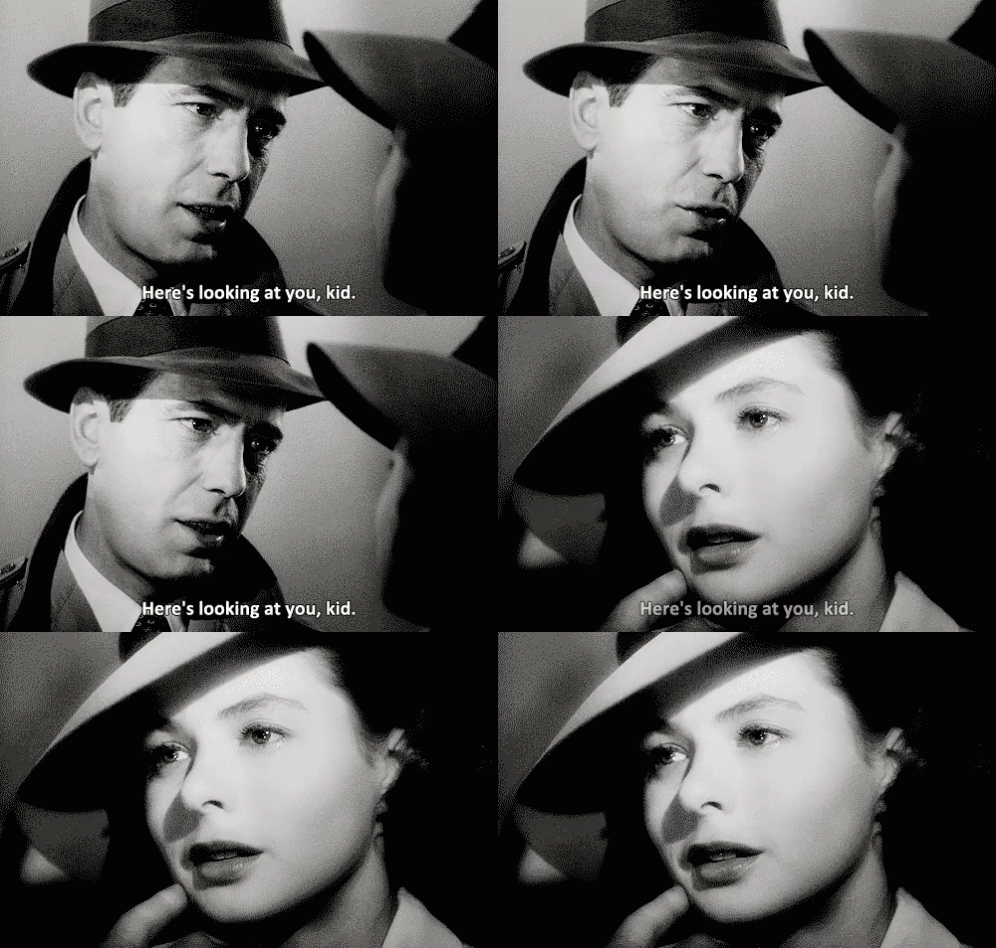
What look is looking back at you and me? And how has that look impacted our lives?
As a child abuse survivor, I know that a look is not just a look. It can signal things beyond love, like hate, rejection, and violence.
And a look can have everything to do with attunement… or the lack thereof.
“(Elohim) The LORD hath appeared of old unto me, saying, ‘Yea, I have loved thee with an everlasting love: therefore with lovingkindness have I drawn thee.’”
Jeremiah 31:3
Attunement… or a world of harsh?
Attunement can be defined as being receptive to or aware of another person. It’s about the present connection, person- to- person. It is recognition and validation.
And it is largely accomplished through facial interaction.
Who is looking at us, and how are they looking at us?
For many of us, this is a distorted reality.
Often, we get these kinds of facial experiences instead.
“I will instruct you and teach you in the way you should go: I will guide you with My eye.”
Psalm 32:8
The Missing Face…
Sometimes, attunement is missing in action. The person’s face is just not there.
“Their” face does not connect with us in the much-needed loving, healthy, and meaningful ways.
“Nature abhors a vacuum.”
Aristotle
Because of the abusive dynamic within my own family of origin, as a child, I often drew primitive faces on the wall next to my crib.
Was I reacting to a face vacuum?
Whose face was MIA?
My dad’s? My mom’s?
The answer to those questions is “yes, both.”
But it’s more complicated than that.
My dad was largely the obvious missing face, even while he resided in the home. He didn’t look at me much.
He was MIA while being there.
There are numerous reasons for the absence of someone’s face. Death, divorce, and abandonment can physically remove someone from us.
But things like a parent’s job, abuse, addiction, and dysfunction also play a role in being “missing.” These people are just not there.
The experience of the missing person’s face still haunts us, nonetheless. They can represent a ghost, a legend, a myth, and a villain to us, because of their absence.
But their facial presence is still sorely missed. We can, therefore, spend our lives trying to seek out their absent faces, either by continuing to seek them directly, or substituting them with another “surrogate’s” face.
But it is still devastating to know the original face will not look at us.
It’s not our fault. It’s beyond anything we did or did not do. They didn’t and don’t have the ability and/or the willingness to attune to us. We deserved their attunement.
Nevertheless, we must accept that their face and their attunement in our lives will not happen.
Sometimes, the distorted face we experience is that of the chaotic, unpredictable kind…
“Since you were precious in my sight… I have loved you…”
Isaiah 43:4
The Distracted Face…
This is often the byproduct of abuse and dysfunction. It comes through instability and inconsistency.
We can’t count on it. Sometimes, there’s a face; sometimes, there isn’t. Despite our needs.
The message?
“I am not safe; I am not important. No one is paying attention to me in a reliable way.”
Now, if we experience this distracted face as a baby or as a child, we don’t have sophisticated language to understand what’s going on. We often just feel fear, rejection, and high stress.
Studies have been done on mothers and their babies, focusing on the impact of a mother’s facial expression with her child. Mothers, especially, are regarded as our first mirror, reflecting the state of our surroundings.
In these mother/child face studies, a smiling, present face, with locking eye contact, promotes the baby’s relaxed sense of well- being. The baby smiles, mirroring its mother’s smile.
However, when the mother is asked to avoid eye contact and connection, refusing to look at her child, the baby starts showing signs of upset and stress. Often, the baby reaches out and cries, desperately wanting to get the mother to look at them again.
If the mother reconnects and smiles, often, a relaxed smile returns to the baby’s face.
Order has been restored. All is well again.
What cues was I picking up, as my mother was the abused wife of my dad’s?
Through abuse, how were my parents distracted in their facial communication?
Oversimplifying my dad, he was more interested in his job than he was in me. I don’t think my dad saw spending time with his child as valid and profitable.
He didn’t invest in me.
He provided, financially, and that was about it.
Things were more straightforward regarding my dad’s missing or distracted face. I wasn’t worth it. His face was better spent elsewhere. So, that’s where he went.
At the most, I got his frustrated, disapproving, or angry face.
But, with my mother, there were more confusing layers to her missing and/or distracted face.
Was it because of post-partum depression that went undiagnosed and NOT dealt with in a caring way?
I believe that, yes, that was part of the answer. There wasn’t much known, nor discussed, at the time. There was little-to-no empathy for the multifaceted challenges that came with that motherhood experience.
And then, you add marital abuse?
Yeah, I was not going to get my mother’s focused, loving, and present face.
Mom’s priority and focus were not about attunement with me. Rather, it was about keeping the peace and keeping my dad’s abuse at bay.
The overarching message here?
“Attention needed to be paid toward averting danger and threat. That was the priority, not attuning to me. “
Emotions were not regulated, nor were they deemed acceptable. Sadness, tears, and any unhappiness were forbidden.
And, certainly, at the top of the forbidden feelings and facial expression list…
Anger.
Therefore, cue more of a repetition of this face…
“This is my commandment, That ye love one another, as I have loved you.”
John 15:12
The Cruel Face…
Anyone can look angry from time to time.
The cruel face, however, is different. It is more sinister, more threatening, and more intentional.
It is the harmful look of abuse. It glares at us through violent, intimidating, and violating facial expressions, ranging from that of a mocking superior smirk, to that of the malicious face of a predator.
It certainly is not the face of love and kindness.
The obvious cruel face was that of my dad’s. He was an emotionally immature, raging abuser.
His face matched that.
I feared my dad, face and all. But I could count on his cruelty, through his obvious, loud raging sessions.
I couldn’t say the same about my mother’s cruel face.
Mom’s threatening face was covert.
Hidden. Subtle. Sneaky. Camouflaged. More unpredictable.
And passive aggressive.
Hence…
The “Spank Spoon...”
“Love is patient…”
1 Corinthians 13:4
Deferred attunement to a kitchen utensil?
Yes, Sirree Bob. It was about keeping my obedience. Not for my benefit, but for the abusive system’s benefit.
When I was a child, if I was acting in a way that was displeasing to her, I would hear the kitchen drawer slide open, to reveal a large wooden spoon. There was an angry inanimate face drawn on it; it was black marker lightning bolt eyebrows, over black slits for eyes, and a mouth of jagged teeth, threatening to bite me. It was scary. I was terrified.
And that was the point.
After all, most four- or five-year-old children would be frightened. The facial expression was clear. It conveyed “you’re in trouble.”
This “Spank Spoon” was her menacing henchman. “The Enforcer” was there to do her dirty work.
Mom would pull this utensil out of the drawer, with much ominous drama. She’d often have a smirk on her face, as the spoon swayed back and forth in her hand.
“You’d better behave or else.”
Furthermore, the utensil also taught me her necessary message: “you will fear me.”
It’s still cruelty. To those who have a similar mindset to that of my mother’s, there can exist, perhaps, this thought:
“The only face I want my child to see is a scary face. They are easier to control that way.”
It was quite an effective tactic during my formative years. Its cruelty included the more complicated, anxious element that was the threat of a threat.
This threat of the threat, however, was never quite carried out.
It was the confusion about never quite knowing for sure where one stood with consequences and punishment. But the threat was present, all the same.
There’s sadism added to the cruel face.
The smirk. The unsafe facial expression of someone who has power over you, and fully intends on abusing it, for their purposes.
The Cruel Face is the look of DELIGHT in someone’s terror. The priority is not attunement, but the adult’s concept of power, control, and domination.
These things, often, can translate into the dysfunctional adult’s warped sense of self.
And yes, we, as children, can pick up on that with our antennas.
We know that we are not loved, valued, and looked after.
We know that there is something more untrustworthy and unsafe at work.
We know that the person is only interested in being all-powerful, often, at our expense.
We know we are collateral damage, sacrificed to that end.
All these Faces are Distorted Faces.
“We love Him, because He first loved us.”
1 John 4:19
They all are opposed to attunement.
Sweet faces looking at us that signal love was what we should have received.
The sweet face attuning to us is without guile, agenda, harm, or evil. The sweet face loves, nurtures, affirms, and protects.
This is what it should be.
Many of us, however, have not experienced this face.
And how many of us have been manipulated by a false “sweet face?”
I see a bunch of hands in the air.
When it comes to the sweet attunement face, often, confusion and agendas are present.
So, what are we to do with that? Sink into despair?
Well, there is another option.
We become our own mirror.
Mirror, Mirror…How to reapply “The Face…”
“As in water face reflects face, So a man’s heart reveals the man.”
Proverbs 27:19
Mirror work.
This often-used therapy technique involves us positively affirming ourselves by looking into a mirror, and communicating, not only loving words, but the matching loving facial expression.
So, we display a smile, a look of sensitivity, acceptance, gentleness, and compassion.
Now is our chance to lovingly look at ourselves this way.
Can we attune to ourselves?
Can our faces be the antidote to the missing, the distracted, and the cruel faces we have encountered?
It can be scary and awkward. Yet, mirror work can apply to each distorted face we encountered.
Regarding “The Missing Face…”
We need to start with the basics.
Look.
We need to look at ourselves. Show up.
A no-brainer?
Well, how many of us spend the least amount of time we can in front of our own reflection?
How many of us have learned we also need to abandon ourselves?
Since no one else is looking at us, why should we?
We don’t like what we think we see looking back at us. “Something” is usually “wrong” with us.
But that “something” is usually taught to us by “someone else.”
We need to look at ourselves. We need our present face.
We need to see ourselves, no matter who else went missing.
Our Mirror for “The Distracted Face…”
Now that we see our faces, we must not look away again.
We need to linger. Don’t rush.
It’s easier said than done.
It’s a hard and painful act to continue to look at ourselves.
To look at ourselves with love, without harm and abuse, to make that decision and that commitment?
We typically don’t know what’s that like.
Instead, we are used to someone in our lives deeming someone or something else as for important than us.
Sometimes, that person might be there. And sometimes, they prioritize another person or thing, like their job or their addiction.
The devastating, rejecting impact of that distracted message often has us deciding that we are not worth our own focused gaze.
So, it can be hard work to stay put in front of the mirror, looking at and affirming ourselves. We can choose to resist the urge to look away, to become distracted with anything else we tend to see as “more important.”
But we can work to see that our own gaze and self-acceptance is, indeed, of the utmost importance.
It doesn’t come quickly, easily, or regularly.
Like most things in life, it takes practice.
The Cruel Face:
And likewise, kindness also takes practice.
Smile. Show kind eyes and compassion, not judgment.
Many of us have only seen angry, abusive, scowling, and mocking faces. Therefore, we internalize those faces, and they unconsciously become our view of ourselves. We can pick at every “flaw.” This applies to our physical traits, but it goes deeper than that. It involves our personality traits. It becomes a free-for-all attack on the essence of who we are.
And of course, our self-harm goes with us wherever we go. It doesn’t just stay in the mirror.
So how do we look at ourselves with kindness, acceptance, and love?
What if we just can’t mirror kindness towards ourselves?
Again, we are back at “do-it-yourself.”
Yes, this is difficult. But finding a separate kind face elsewhere, to mimic in our own faces, can start the process of our self-acceptance in our mirror work.
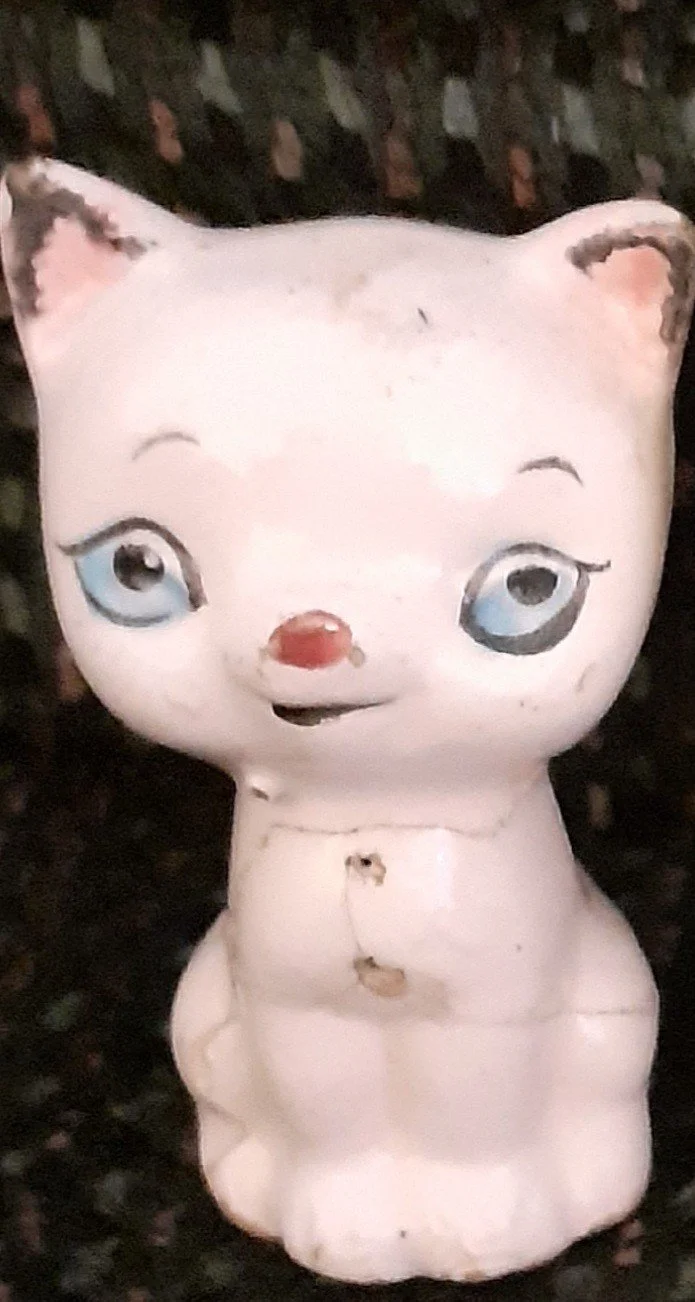
What does a sweet face look like?
Can we mimic our version of that face?
I found a loving, kind facial expression in an inanimate kitten figurine.